by Ruth A. Symes
Link to buy my books Amazon.co.uk: Ruth A Symes: books, biography, latest update

Franz Winterhalter, Queen Victoria wearing a floral crown of orange blossom (1847). Via Wikimedia Commons
[This article was first published in Family Tree Magazine UK in 2011]
Kate Middleton’s wedding bouquet follows royal tradition by including a sprig of myrtle from the bush in Queen Victoria’s personal garden at Osborne House on the Isle of Wight. The myrtle (a star-like flower with creamy white petals and dark green leaves) traditionally symbolises love, affection, joy and happiness. It has graced all the important royal bridal bouquets from the mid nineteenth century onwards and is just one prominent example of the way in which flowers have long been important in sealing the traditions of a family’s history. There are many more. Indeed, since flowers have always been called upon in the celebration of courtships, marriages, births and deaths, you may come across them frequently in the photographs, written records, mementoes and monuments of your family’s history.
Courtship
It was common for Victorian lovers to present their intended with a floral bouquet at the beginning of a courtship. This was often a selection of herbs surrounding a flower or flowers, all chosen for their meanings. Indeed, throughout the betrothal process, Victorian lovers might send hidden messages to each other by way of flowers. Of course, few of our ordinary Victorian ancestors would have been experts in the language of flowers, but some symbols would have been widely understood. Marigolds (or calendula), for example, symbolised sorrow and despair but by adding a poppy, symbol of consolation, to the bouquet, the sender of flowers might suggest that he could soothe his lover’s grief.
The association between flowers and emotions was age-old but by the end of the nineteenth century it had developed into a complex language of flowers. ‘Floriography,’ as it became known, might be of interest to you as you research your family if you have inherited heirlooms which may have been given as gifts between lovers: items of jewellery, clothing embroidered with flowers, ornaments and the like. Beware, however. Dozens of dictionaries of floriography were published in the nineteenth century and they don’t necessarily agree with each other about the meanings of certain flowers! A selective list taken from the popular Sunlight Yearbook of 1898 appears below.
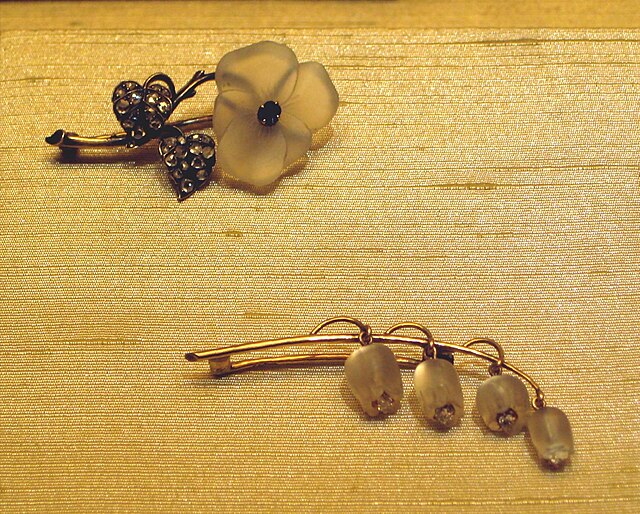
Flower brooches, Faberge, 1887-1896. Via Wikimedia Commons.
Weddings,
Marriages, of course, have traditionally been the occasion of the most meaningful floral displays. Indeed, the union of a man and a woman, throughout history has rarely gone ahead without these colourful and sweet-smelling symbols of joy and fertility. Bouquets of flowers, known as poseys, nosegays or ‘tussie-mussies,’ have been carried by flower girls at weddings for centuries. And, until modern times, the choices of flowers in these and the bridal bouquet have depended far more on the symbolic meaning of the flowers involved than on their shape and colour.
Some of the symbolic meanings of flowers called upon at our ancestors’ weddings were of ancient pagan origin, some had significant Christian meanings and still others took on meanings that were of particular importance to our society at a particular time. By the Victorian period, for example, the myrtle favoured by our twenty-first century Princess Katherine had come to symbolise duty, affection, discipline and home – the true values of Victorian womanhood – as well as simple love. At some weddings, the subtlety of the flower arrangements were quite breathtaking: flowers could, for example, take on different meanings depending on whether they were placed in the cleavage, in the hair or over the heart. Sometimes a collection of different flowers were chosen for the messages spelt out by their first letters: for example, Lilac, Orange Blossom, Violet and Euphorbia.
Regency bridal bouquets such as those that would have been carried by Jane Austen’s heroines included flowers such as roses (love), peonies (riches and honour), sweet peas (blissful pleasure), lillies (life) and delphinium (levity) as well as herbs such as sage which were thought to ward off bad luck, evil spirits and poor health. Greenery such as ivy (the Christian symbol of eternal life) or thistle (symbol of protection) was also included. Sprigs from the bouquets were sometimes planted by the bridesmaids at the home of the bride and groom after the wedding to ensure marital contentment. If the sprigs took root quickly and bore bushes, it was deemed likely that the bridesmaids themselves would soon marry,
Look out for the bridal bouquets in photographs of weddings that took place in your family in the Victorian period. They often included rosemary (an ancient symbol of faithfulness) and orange blossom (a symbol of chastity). The type and number of bouquets in evidence in a group wedding photograph will give you some evidence of your ancestors’ wealth and social status – or at least of the economic prosperity of the times. In the 1940s, an era of austerity, bridal bouquets – particularly those arranged in haste when a serviceman was on leave – were characteristically small and unostentatious with flowers such as chrysanthemums plucked from the bride’s garden sometimes being used.
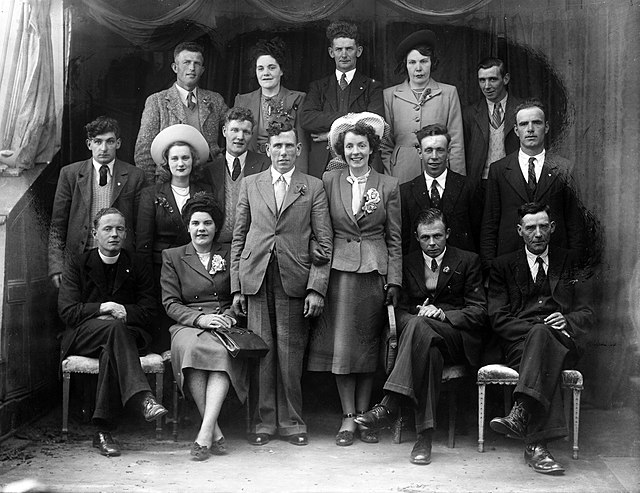
Flowers are in short supply at this wedding which is one factor which helps date the event to the 1940s, a period of austerity either during or just after World War II, The Doyle Wedding, Co. Kilkenny, Via Wikimedia Commons
And when trying to date other kinds of evidence such as jewellery, painted pottery or glassware, don’t forget that wedding anniversaries have traditionally been associated with certain kinds of flower: from carnations given after one year, to daffodils after ten, asters after twenty, irises after twenty five, lillies after thirty, gladioli after forty and lillies and violets after fifty. A photograph showing a woman wearing a corsage of scabious indicates that she is recently widowed.
Births
Your family birth certificates may remind you that in the late nineteenth and early twentieth centuries, some of the older, more traditional names for girls (such as Anne, Jane and Elizabeth) were dropped in favour of what must have appeared the more trendy or fashionable ‘flower’ names. ‘Violet’, for instance came into vogue in the last two decades of the reign of Queen Victoria; there are two famous examples in the politician, Violet Bonham-Carter (1887-1969) and the writer, Violet Needham (1876-1967). ‘Daisy’ was a common nickname for Margaret at the end of the nineteenth century (the French flower being known as a Marguerite). The name ‘Iris’ (as in the writer Iris Murdoch (1919-1999) was particularly popular in Britain between 1900 and 1920.
Whatever your ancestor’s name, flowers (or gifts bearing pictures of flowers) have traditionally been given at the birth of a baby and at his or her christening to celebrate new life. Flowers at christenings and births are associated with distinct months of the year:
January – Carnation
February – Violet
March – Daffodil
April- Dahlia and Sweet Pea
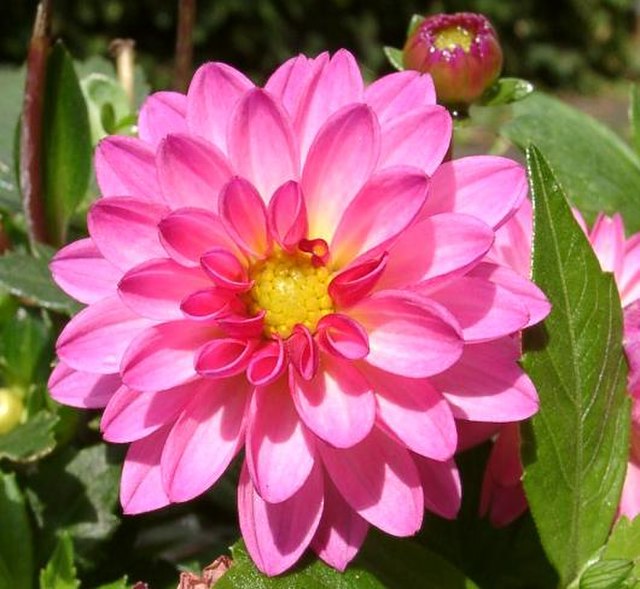
Flower for April – Dahlia Dhalstar Sunset Pink, via Wikimedia Commons
May – Lily of the Valley and Sunflower
June- Honeysuckle and Rose
July – Larkspur
August- Lily and Gladiolus
September – Forget-me-not and Aster
October – Calendula, Rose and Camelia
November – Crysanthemum
December – Holly and Narcissus
Deaths
Flowers as symbols of the brevity and transiency of life have long been presented at funerals. They have also traditionally had a more practical purpose, to offset the smell of the decomposing body! In the distant past, churches were filled with flowers on religious occasions but the Reformation put paid to this and Protestant churches were without flowers until they were reintroduced at the end of the nineteenth century. An interesting aspect of this for family historians is that floral tributes (together with the names and home towns of those donating) are often recorded at the end of newpaper obituaries in local papers.
From the late Victorian period, flowers and foliage have appeared on memorial carvings alongside poignant personalised inscriptions. Lillies are very popular motifs on headstones and here symbolise the restored innocence of the soul at death. Other common flowers and greenery used in memorial carvings are the passionflower (symbolising the Passion of Christ), roses (love), and ivy (symbolising eternal life). Sometimes flowers on memorial carvings are depicted with the stem broken to represent a life cut short. An unusual feature of some Victorian cemeteries are glass-domes under which flowers were kept.
Flowers in the Marital Home
It was the duty of every middle-class housewife of the Victorian era to provide a happy, healthy and aesthetically pleasing home. The variety and splendour of flower decorations in an individual house said a lot about the wealth, social standing and ‘taste’ of particular families and flower arrangement was one of the few practical tasks that the middle-class housewife did not leave to the servants.

Frederick Leighton, ‘Mrs James Guthrie’, 1864. Via Wikimedia Commons.
Advice writers went to great lengths in instructing women what to do with the flowers at their disposal, though the choice of blooms was, of course more limited than it is now, and exotic flowers could only be grown by those who could afford hothouses. In the month of May 1892, one woman’s magazine suggested the following complicated domestic flower decorations for the table “For a dinner party this month, make a bank of ivy down the middle of the table, using thick bushy pieces to raise it in the centre, and trails of the smaller kind to fringe the edge, these coming nearly to the line of the wineglasses, and at the corners right to the edge of the table, winding round any small dishes of olives or sweets which may be needed. [Include also] six white china vases, containing each a well-grown head of lemon colour or terra-cotta azalea, with some light sprays of very vivid green asparagus or young fern.’
Flowers in the home of course were not purely used for decoration. Some were employed in the kitchen and your ancestor’s handwritten recipe books may contain some surprises: marigolds, for example, were used in soup by the poor as an alternative to saffron. Other flowers were used as primitive medicines. Those who could not afford expensive pharmaceuticals may have resorted to the hedgerow in the treatment of family ailments: hyacinth bulbs, for example, were used in the treatment of diphtheria in the late nineteenth century.
Whether you are lucky enough to have the preserved flowers of your grandmother’s bridal bouquet, a photograph of your great-aunt wearing an unusual corsage or the Forget-Me-Not earrings presented to your mother during the Second World War, spare a thought for the meanings that may have gone into their choice and for the people to whom they meant so much.
Selective Alphabet of Flowers and their meanings (as understood at the end of the nineteenth century).
Acacia – Pure Love
Bachelor’s Buttons – celibacy
Carnation (red) – Alas for my poor heart
Daisy – Innocence
Everlastings – Unending Remembrance
Foxglove – An Insecure Acquaintance
Geranium (red) – Consolation
Hazel – Reconciliation
Ivy – Fidelity
Jasmine (white) – Aimiability
Lavender – Distrust

Lavender for Distrust. Via Wikimedia Commons.
Myrtle – Love
Orange Blossom – Purity
Peony – Shame
Quaking Grass – Agitation
Rose (yellow) – Jealousy
Snowdrop – Hope
Tulip (Red) – Declaration of love
Violet – Faithfulness
Willow – Mourning
Useful Books
Tussie-Mussies, the Victorian Art of Expressing Yourself in the Language of Flowers, Workman Publishing 1993
Nugent Robinson, The Language of Flowers, P. F. Collier, 1882.
Bobby J. A. Ward, A Contemplation Upon Flowers: Garden Plants in Myth and Literature, Timber, 2005
Marina Heilmeyer, The Language of Flowers: Symbols and Myths, Prestel, 2001.
Useful Websites
http://www.felbridge.org.uk/index.php?p=2_48 Descriptions of headstones – among them many floral ones – in the cemetery of St John the Divine, Felbridge.
http://www.weddingguideuk.com/articles/planning/chooseflowers.asp Some facts about wedding bouquets throughout history.
http://www.buzzle.com/articles/list-of-flower-names-and-meanings-of-flowers.html Flowers and their meanings.
For more on flowers and other accessories that can tell you more about your family history, see my book:

For Social History and Women’s History Books https://www.naomisymes.com/

Discover more from searchmyancestry - Ruth A. Symes
Subscribe to get the latest posts sent to your email.

Leave a comment