By Ruth A Symes
Link to buy my books Amazon.co.uk: Ruth A Symes: books, biography, latest update
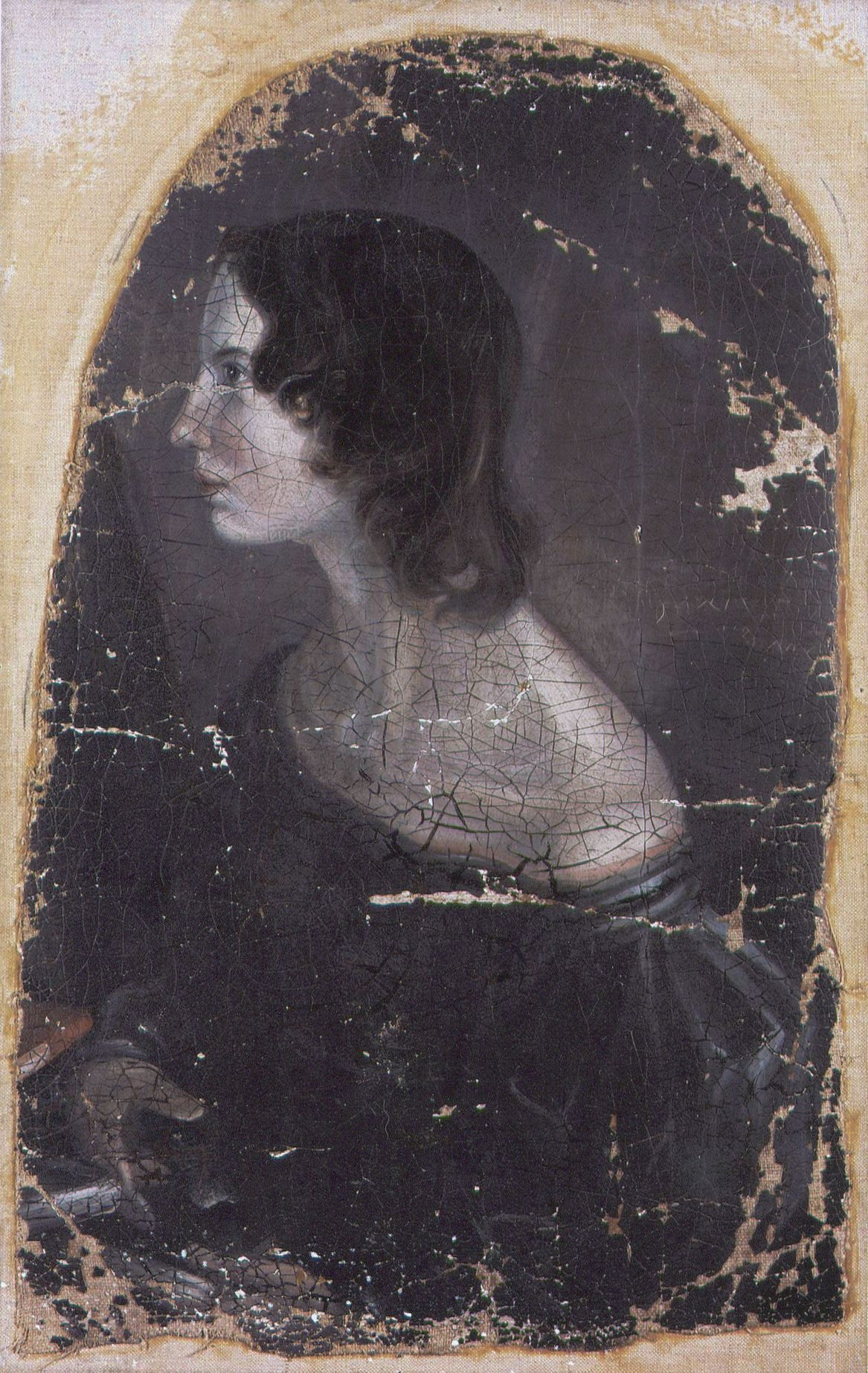
Fragment of a larger portrait. But is this Emily or Anne?
National Portrait Gallery via Wikimedia Commons
[A version of this article was first published in the family history press in 2018]
With the recent release of the latest film version of Wuthering Heights, attention has circled yet again to the author of that formidable book – Emily Bronte. Information about how this most enigmatic of writers actually looked is particularly sparse. An investigation into Emily’s appearance, however, might helpfully draw attention to some unusual ways of perhaps finding out what our own ancestors looked like when none of the obvious sources are available.
There are no authenticated photographs of Emily Bronte. After all, she died in 1848, when photography was in its infancy. A recently discovered photograph claiming to be of ‘Les Souers Bronte, Londres’ looks more likely to be of three unrelated women taken in the 1850s. (Take a look at it at https://www.bronte.org.uk/whats-on/news/9/is-this-a-photo-of-the-bronte-sisters-together). Experts believe that it is highly unlikely that Emily or Anne were ever photographed given the relative poverty of the Bronte family and the fact that they were not well-known during their lifetimes.
Luckily for us, whilst the Bronte sisters would not, normally-speaking, have been candidates for portraiture during their lifetimes, they happened to have a painter in the family in the shape of their brother Branwell. Our main knowledge of Emily’s appearance comes from his portrait of all three sisters painted in 1833. Here the sister most generally taken to be Emily is a tall languid-eyed woman with a rather prim face surrounded by auburn curls. But Branwell’s portraits were notoriously inaccurate and when, after their deaths, Arthur Bell Nicholls, Charlotte’s husband, was asked which sister was which in the portrait he couldn’t be sure. There is a second portrait of just one of the sisters (a fragment also kept in the National Portrait Gallery). The sitter was identified by the long-term friend of the Brontes, Ellen Nussey, in the 1870s as AB (Anne Bronte). It has more recently, however, been described as Emily.
Other than the portraits, there are no physical representations of Emily Bronte to ponder over. To find out anything else about her possible appearance we must turn to written accounts. The first (and presumably most likely of these to be accurate) is by her older sister Charlotte. In her Biographical Notice to the 1850 edition of Wuthering Heights Charlotte commented that Emily was ‘stronger than a man, simpler than a child, her nature stood alone,’ and whilst this is meant to be a description of character rather than appearance, it does allow for a physical picture of sorts. It has also been suggested that the heroine of Charlotte’s novel Shirley (1849) uses Emily as a model. Indeed, Charlotte told her friend and biographer, Elizabeth Gaskell, that Shirley was ‘what Emily Brontë would have been had she been placed in health and prosperity.’
Meanwhile, Ellen Nussey wrote about Emily as she appeared to her at the age of 15 on her first visit to the parsonage at Haworth in July 1833:
Emily was the tallest person in the house, except her father. Her hair, which was naturally as beautiful as Charlotte’s, was in the same unbecoming tight curl and frizz, and there was the same want of complexion. She had very beautiful eyes – kind, kindling, liquid eyes; but she did not often look at you; she was too reserved. Their colour might be said to be dark grey, at other times dark blue, they varied so. She talked very little. She and Anne were like twins – inseparable companions, and in the very closest sympathy, which never had any interruption.
Reminiscences of Charlotte Bronte (1871)
Another telling observation was made about Emily by a fellow pupil from the Pensionatt Heger in Brussels in 1842 (once attended by Charlotte and Emily). Evidently she was not a fashionable girl, preferring to wear the outdated romantic leg-of-mutton sleeves of the 1830s rather than the narrower sleeves of the day, and no corset. Indeed, she eschewed physical adornments of any kind and said that she preferred simplicity or, in her words, ‘to be as God made [her].’
A final first-hand account of Emily’s appearance comes from Tabitha Ratcliffe, the sister of Martha Brown, one of the Bronte’s servants who was asked what she could recollect of the Bronte sisters as late as 1910. She observed:
I believe Charlotte was the lowest and the broadest, and Emily was the tallest. She’d bigger bones and was stronger, longer and more masculine, but very nice in her ways.’ In Cautley Holmes Cautley, ‘Old Folks Who Knew the Brontes’ (1910) in Cornhill Magazine, July 1910.
Finally, there are some – if you like – sidelong clues as to what Emily might have looked like. Charlotte Bronte had a bracelet, adorned with an amethyst, which was made from the entwined hair of her two sisters after their deaths. Allowing for the transformations of time, both appear to have been auburn or light brunette. (https://longreads.com/2015/06/30/death-made-material-the-hair-jewelry-of-the-brontes/) We also know – as facts – that Emily was tall and thin. The dimensions of her coffin made by the village carpenter were five foot seven by 16 inches across. It was the narrowest coffin that the village carpenter William Wood had ever to make for an adult.
Of course, the continued puzzle about how Emily Bronte actually looked reminds us of our eternal fascination in the appearance of our own ancestors.
How to Find Out More
- Ask all your living relatives if they have any old photographs that potentially could be of your ancestors. Don’t forget that some old documentation – such as old passports – might include photographs.
- Join one of the many commercial family history websites (www.ancestry.co.uk, www.findmypast.co.uk, and www.thegenealogist.co.uk) to see if anyone ese is tackling your family tree and if so, whether they have included any photographs.
- Books and websites covering the local history of the town or village from which your ancestor came might have labelled photographs of local characters. Look for books by keyword at www.amazon.co.uk and http://www.abe.com.
- Ask yourself if your ancestor was wealthy or important enough ever to have had his or her portrait painted. If unidentified paintings held by your family don’t reveal anything then investigate online portrait websites such as http://www.theportraitdatabase.com/index.html or http://www.npg.org.uk/.
- Check out the family jewellery box. Are there any items which might include (or be made entirely from) an ancestor’s hair – such as a mourning ring, brooch or bracelet? Look also for jewellery – buttons, necklaces, earrings – that includes cameos or intaglios (engravings). From 1774, the potter Josiah Wedgwood made portrait medallions of people in profile, semi profile or full face.
- Next, look for written accounts of how your ancestors looked. Family papers such as diaries and letters might mention telling details about an ancestor’s height, weight, strength or degree of attractiveness.
- Check out newspaper articles about events that involved your ancestor, or obituaries in journals (see for example, www.britishnewspaperarchive.co.uk).
- Prison records and transportation records from the mid nineteenth-century onwards (available from the commercial genealogy sites) often include detailed physical description of convicts – the former even including photographs.
- Passenger lists such as those for workers emigrating to America in the early years of the twentieth century (found as above) also often record height, eye colour and distinguishing characteristics such as tattoos or physical abnormalities.
- Clues to appearance are occasionally found within the epitaphs on family gravestones.
Finally, think laterally. Did your ancestor belong to a typical sociological group that might have been formally documented somewhere? Lancashire miners in the early part of the twentieth century, for example, were marvellously documented by George Orwell in his Road to Wigan Pier like this:
Most of them are small (big men are at a disadvantage in that job) but nearly all of them have the most noble bodies; wide shoulders tapering to slender supple waists, and small pronounced buttocks and sinewy thighs, with not an ounce of waste flesh anywhere… ‘
In the absence of photographs, this is an informative and striking description of many of the working men of Lancashire eighty plus years ago. Using gems such as this, it’s just possible that some of our ancestors might no longer need to ‘walk invisible.’
Further Reading
Barker, Juliet. The Brontes. Abacus, 2010
Barnard, Robin, Emily Bronte (British Library Writers’ Lives), British Library Publishing Division, 2000
Chitham, Edward, A Life of Emily Bronte, Wiley-Blackwell, 1987
Frank, Katherine, Emily Bronte: A Chainless Soul, Hamish Hamilton, 1990
Gerin, Winifred, Emily Bronte: A Biography, Oxford Paperbacks, 1979
Trailer for Wuthering Heights (2026)
Discover more from searchmyancestry - Ruth A. Symes
Subscribe to get the latest posts sent to your email.

Leave a comment