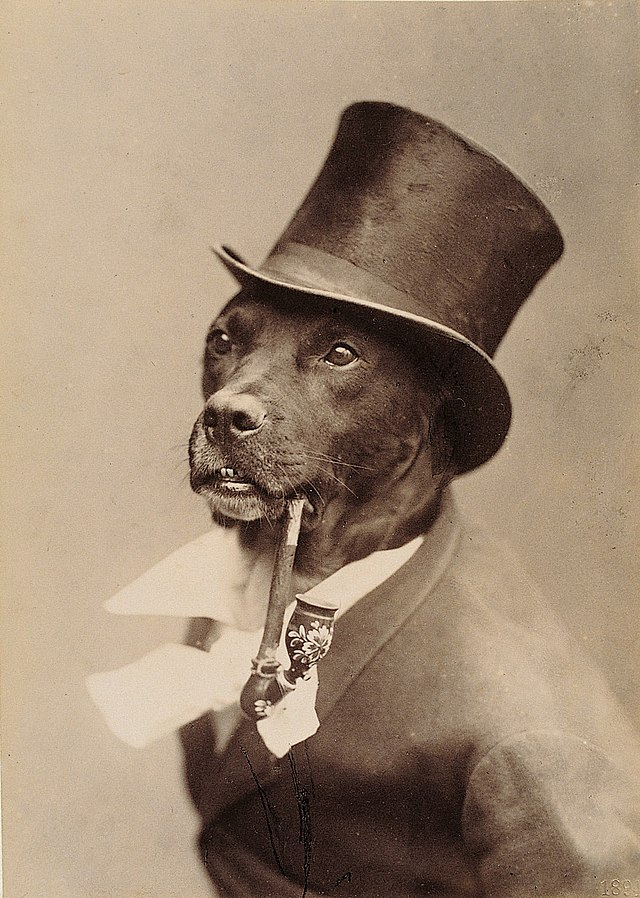
Dog in a top hat. Bonque and Kindermann Photographers, Germany, 1894. Via Wikimedia Commons. [[File:Dog in top hat.jpg|Dog_in_top_hat]]
[This article was first published in Dogs Monthly in 2012]
How often have you cooed over a dog in an old family photograph – the Great Dane stretched at the feet of its master; the Red Setter artistically seated next to a little girl with curls; a poodle snuggled up on great-grandmother’s knee?
In the past, dogs provided our ancestors with company, comfort, sport and livelihood – and, as today, they were often considered as important members of the family sharing in festivities such as birthdays, weddings and holidays – indeed all the occasions upon which a photograph might have been taken. And because of all this, the presence of a dog before the camera may help you to discover quite a lot about your family history.
Dating a Dog Photograph
First a dog in an otherwise undated sepia print may help you put a date to the photograph. The long exposure times of very early photography – which required that the sitters keep still for a few minutes at a time – were obviously not ideal for the portrayal of pets, but from the 1860s onwards (with shorter exposure times), animals of all kinds made more of an appearance before the lens and dogs were particularly popular. Cherished pooches even appeared alone in pet portraits on cartes de visite or the slightly larger ‘cabinet cards’.
It’s worth remembering that some breeds of dog did not exist until certain dates in the nineteenth and twentieth centuries, and that others became extinct at various points. Take the Golden Retriever, for instance. Any photograph featuring one of these has to have been taken after 1862 – and probably somewhat later. Improvements in firearms in the mid-Victorian period meant that more game was being shot by huntsmen on increasingly difficult terrain. Sir Dudley Marjoribanks – a Scottish gentleman – wanted to breed a dog that would be a good retriever of such birds but that would also be gentle and trainable. To this end in 1862, he crossed a male yellow-coloured Retriever, Nous, with a female Tweed water Spaniel, Belle. The result was the Golden Retriever – a dog that was to become one of the great British favourites.
Small Dogs
Look out for certain types of small dog in the laps of your great aunts and other female relatives. ‘Toys,’ as these pets were sometimes known, went in and out of fashion. At the beginning of the Victorian period, for example, popular dogs such as King Charles Spaniels were cross-bred with Asiatic breeds to produce supposedly more attractive ‘pug’ dogs with short muzzles. In the 1890s, a favourite miniature dog in London was a small Belgian breed – the ‘Schipperke’ – mainly because its hair was short and black. Long-haired white dogs tended to be less popular because they left visible hairs on furniture and gowns! The Sealyham Terrier – a short white dog bred by crossing corgis with various breeds of terrier – was not officially recognised until 1910. 2,000 such dogs were licensed in the 1920s and the breed was made popular later in the twentieth century by glamorous women such as Princess Margaret. You are unlikely to see a Sealyham in a recent photograph, however. In 2008, it was estimated that there were only 43 such dogs left in Britain!
Dogs and Class Status
Dogs in photographs can also tell you something about your family’s wealth and status in the past. For centuries, dogs were popular with aristocratic families and not so much with people in the middle ranks of society, but from the Victorian period onwards, more and more middle-class people started to keep pets. In 1897, the cost of a dog licence was 7 shillings and 6 pence – not an insubstantial amount at the time – and so having a dog or dogs quickly became one of the many outward signs that a family had ‘made it.’ Indeed, the very type of dog owned by middle and upper class families was increasingly viewed as a barometer of how fashionable they were – functioning in much the same way as a new hat or the length of a hemline.
As many poorer people moved into the cities from the countryside during the Industrial Revolution (from 1870 onwards), they took with them their dogs (the legal requirement of a dog licence was, in fact, widely ignored) and many urban sports involving canines sprang up. Dog baiting survived – using bulldogs and terriers and crosses between the two – even after other bloodsports involving animals had been outlawed in 1835 by the Cruelty to Animals Act (Britain’s first law to protect the welfare of animals).
Dogs and Jobs
Dogs in photographs might also tell you more about what your ancestor did for a living. If a dog is portrayed with an adult male in a photograph, this might indicate – in the same way as the presence of an apron or a knife – that he was a tradesman such as a butcher or baker. Look out for dogs that might reveal family employment as shepherds, huntsmen, or members of the military and police forces. From 1931, dogs may also appear in photographs as guide dogs for the blind.
Doggy Milestones
Finally, your photograph might also relate to one of the important milestones in canine history. By the last decades of the nineteenth century, dogs had achieved a status in British society that they held nowhere else in the world. If the dog in your photograph is evidently at a dog show bear in mind that the first such organised event was held in Newcastle-upon-Tyne as early as 1859, though it wasn’t until 1886 that Crufts was first held as a show for terriers only. If the dog is evidently a rescued stray, remember that the British concern for animal welfare was illustrated by the founding of ‘The Temporary Home for Lost and Starving Dogs’, now ‘Battersea Dogs and Cats Home,’ in Holloway by Miss Mary Tealby in 1860 and the Kennel Club was founded in 1873 to provide information on the welfare, health, training and breeding of dogs.
It’s always annoying when a photograph bears little or no information on the back but before you get too frustrated, do remember that the adorable animal staring out at the lens – so beloved of your ancestors – might just be trying to tell you something.

 searchmyancestry - Ruth A. Symes
Leave a comment