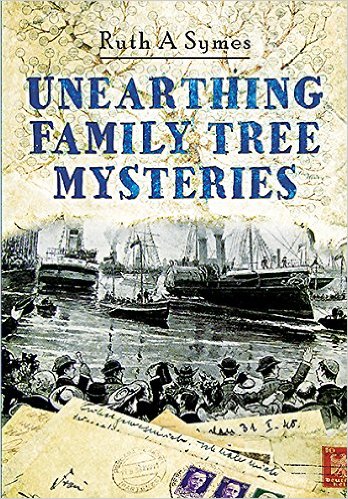
- Unearthing Family Tree Mysteries
Ruth A Symes
Buy my book at Amazon, click this link.

The intriguing characters in these real family history mysteries include an agricultural labourer who left secrets behind in Somerset when he migrated to Manchester, a working-class woman who bafflingly lost ten of her fourteen children in infancy, a miner who purportedly went to live with the Red Indians and a merchant prince of the Empire who was rumoured to have two wives. This book shows how a variety of sources including birth, marriage and death certificates, censuses, newspaper reports, passports, recipe books, trade directories, diaries and passenger lists were all used to uncover more, and how much can be detected by setting the characters from your family tree in their proper historical backgrounds. This book is an updated edition of Ruth Symes previous book, titled Stories From Your Family Tree: Researching Ancestors Within Living Memory (2008).
- It Runs in the Family: Understanding More About Your Ancestors
(The History Press)
By Ruth A Symes
Buy my book at Amazon, click this link.
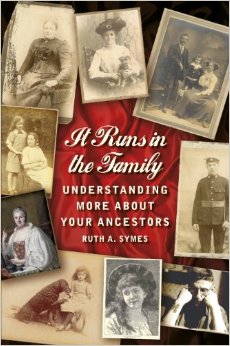
Why didn’t my ancestors smile for the camera? Why did great-grandfather wear a beard whilst his sons were clean-shaven? Should great-grandma really have married her cousin? Was great-aunt unusual to have several children in her 40s? Drawing on evidence from social history, women’s history, and the histories of photography and fashion, to name but a few, this book looks at a number of issues that have long perplexed and amused family historians. Richly illustrated with photographs and drawings from the 19th and early 20th centuries, and using examples from the famous as well the lowly, the book investigates the whys and wherefores of several aspects of personal appearance and dress, and the ins and outs of a whole series of family relationships. It culminates by providing an innovative new methodology for getting more out of the standard documents of family history research – birth, marriage and death certificates.
- Tracing Ancestors Through Letters and Personal Writings: A Guide For Family Historians
By Ruth A Symes
: Buy my book at Amazon, click this link.

Could your ancestors write their own names or did they mark official documents with a cross? Why did great-grandfather write so cryptically on a postcard home during the First World War? Why did great-grandmother copy all the letters she wrote into letter-books? How unusual was it that great-uncle sat down and wrote a poem, or a memoir?Researching Family History Through Ancestors’ Personal Writings looks at the kinds of (mainly unpublished) writing that could turn up amongst family papers from the Victorian period onwards – a time during which writing became crucial for holding families together and managing their collective affairs.With industrialization, improved education, and far more geographical mobility, British people of all classes were writing for new purposes, with new implements, in new styles, using new modes of expression and new methods of communication (e.g. telegrams and postcards). Our ancestors had an itch for scribbling from the most basic marks (initials, signatures and graffiti on objects as varied as trees, rafters and window ledges), through more emotionally charged kinds of writing such as letters and diaries, to more creative works such as poetry and even fiction. This book shows family historians how to get the most out of documents written by their ancestors and, therefore, how better to understand the people behind the words.
From the introduction…..
Amongst their possessions and official paperwork, our ancestors may have left a whole raft of personal writings, from a name etched into the top of an old box, to an appointment diary, a shopping list, a recipe or remedy book, a sheaf of letters or a collection of postcards. Some may have gone further, leaving a trove of intimate detail in letters, a holiday journal, a fragment of poetry or even a full-blown but unpublished manuscript of an autobiography or novel.
In his diary entry for New Year’s Day, 1858, actor John Pritt Harley recorded that : ‘I gave my Dear Sister Betsy a new Pocket Book.’ Harley did not make it clear what use the book was intended for but there were many possibilities. And, as the century wore on, publishers rose to the demand for these pocket and desks books in multifarious shapes and sizes, some no longer filled simply with blank pages but specifically designed for particular purposes: ‘almanacs’, ‘miscellanies’, ‘birthday books’, ‘memoranda,’ ‘commonplace books’, ‘appointment diaries’ and ‘holiday journals’ to name but a few titles.
Whilst we might easily assume that our upper and middle-class ancestors left some written evidence of their lives, it is a common misconception that working-class ancestors did not. Historians of ordinary people have tended to focus on sources that record their spoken words including folklore, stories passed down through a family’s oral history, transcriptions of what was said in a court situation, or spoken words quoted in a newspaper. In fact, however, many ordinary people with low levels of literacy left personal writings which may profitably be analysed by family historians. As one recent commentator, Martin Lyons has put it: ‘Our ancestors’ writings are there if we care to look for them. The problem is not that ordinary writings are scarce and ephemeral: rather there is such an abundance of ordinary writing that the historian hardly knows where to begin.’ (Martyn Lyons, The Writing Culture of Ordinary People in Europe, c. 1860-1920, CUP, 2014)
- Family First: Tracing Relationships in The Past
(Hardback title, Pen and Sword, 2016))
By Ruth A Symes
Buy my book at Amazon, click this link.
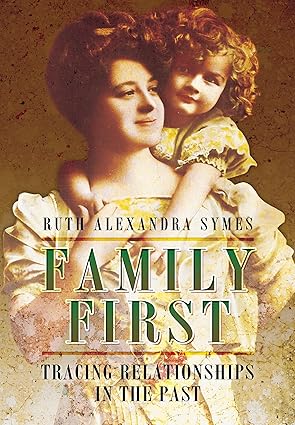
Husbands, wives, fathers, mothers, children, siblings, aunts, uncles, cousins and grandparents – these are the relationships that structure the family tree and fascinate the family historian. But how much do we really know about how our ancestors lived out these multiple roles? Buffeted this way and that by economic developments, legal changes, medical advances, Two World Wars, the rise of the Welfare State, women’s emancipation and many other factors, relationships between members of our family in the past were subtly different to those of today and continually transforming. This book is both a social history of the period 1800-1950 and a practical guide on how to set about tracing and better understanding the relationships between members of your own family. What did it mean to be a father in this period, but also, how might you discover the father of an ancestor if his name is not mentioned on the birth certificate? What common ideas were held about the role of wives and mothers, but also, how were multiple births, stillbirths, abortions and infanticides dealt with in the records? What factors might have influenced the size of your ancestor’s family, but also why were its children named as they were? Did pecking order in a family matter, but also, was it legal to marry a cousin, or the sister of a deceased wife? How long could people expect to live, but also what records can tell you more about the circumstances of your ancestors’ last years? A final chapter considers relationships with neighbours, friends and club associates.