by Ruth A. Symes
[This article was first published in Scots Heritage Magazine in 2016]
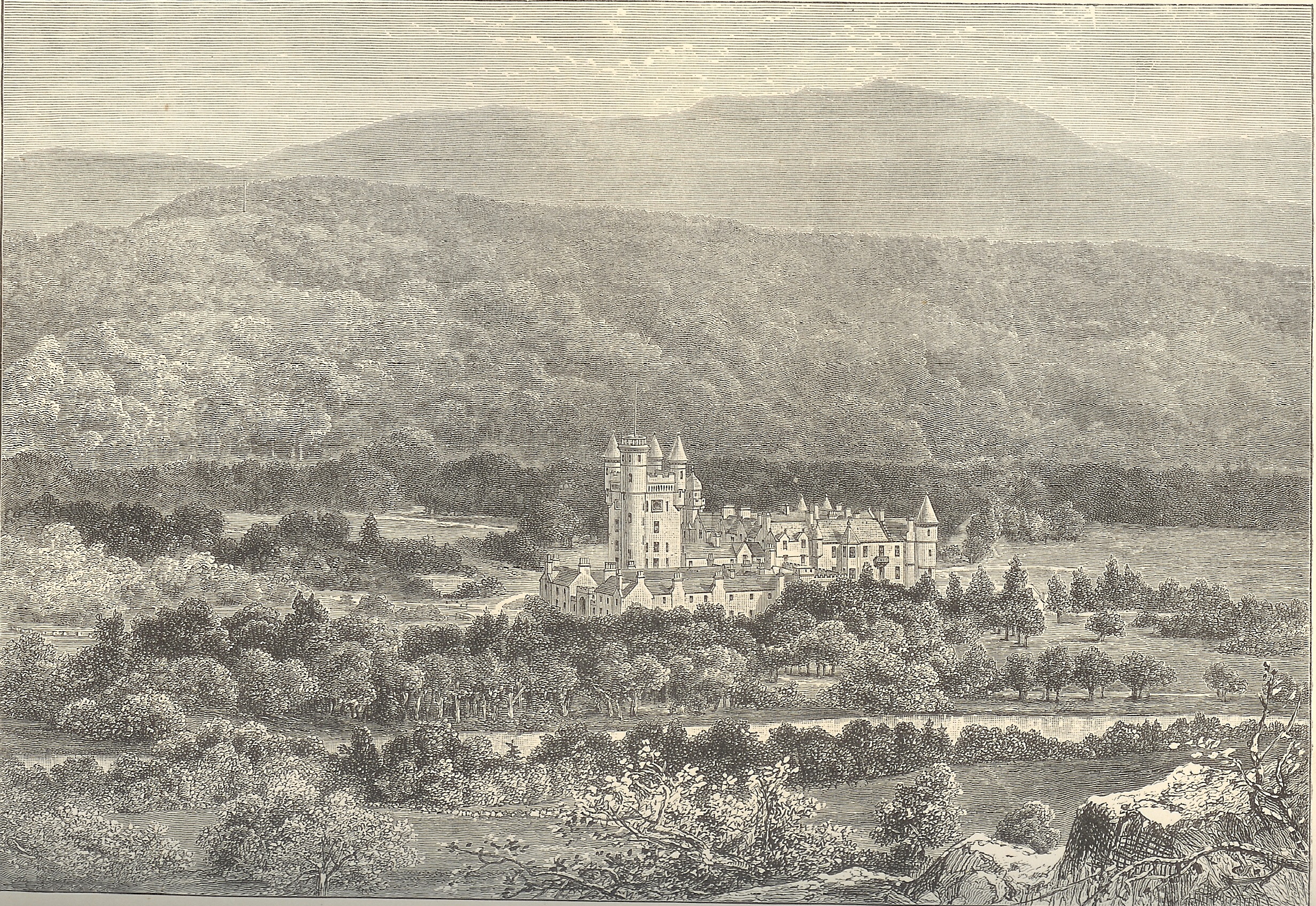
Balmoral in earlier days, Queen Victoria and Prince Albert bought Balmoral in 1848 after spending a happy holiday in the Highlands. In 1853, the original house (believed to date from the 13th century) was knocked down and a new, larger castle was built in its place. This was finished in 1856. Balmoral has remained a favourite residence of the British Royal family and is owned privately by them and not by the Crown.
Credit: From Scottish Pictures Drawn With Pen and Pencil by Samuel G. Green, London: The Religious Tract Society, 1891, p.181.
Link to buy my books Amazon.co.uk: Ruth A Symes: books, biography, latest update
Queen Victoria nearly always spent Halloween at Balmoral and as she grew older participated more and more energetically in the festivities to celebrate the occasion. Her interest started properly in 1866 when, after paying a visit to Mrs Grant, mother of John Grant, Head Keeper at Balmoral, on the afternoon of October 31st she saw children carrying torches, and bonfires appearing on the hills on the other side of the river. These, she noted in her journal, ‘ had a very pretty effect’. (Wednesday 31st October 1866 http://www.queenvictoriasjournals.org/home.do)
By 1868, this trip for tea on the estate prior to joining in the Halloween celebrations was becoming something of an annual ritual for Victoria and her youngest children. ‘Mrs Grant gave us “whisked cream” as she called it, with oatmeal sprinkled at the top, which she said everybody eats on Hallowe’en. At 6 the torches began to be lit up, Louise, Leopold & Christian each carrying one & Lenchen & I drove. On nearing the Castle, numbers met us, & we remained out to see all walking round. Then some reels were danced round a blazing fire, made from a pile of torches. It had a wild effect. Unfortunately the wind was terribly high.’ Queen Victoria’s Highland Journal, 31st October 1868, http://www.queenvictoriasjournals.org/home.do
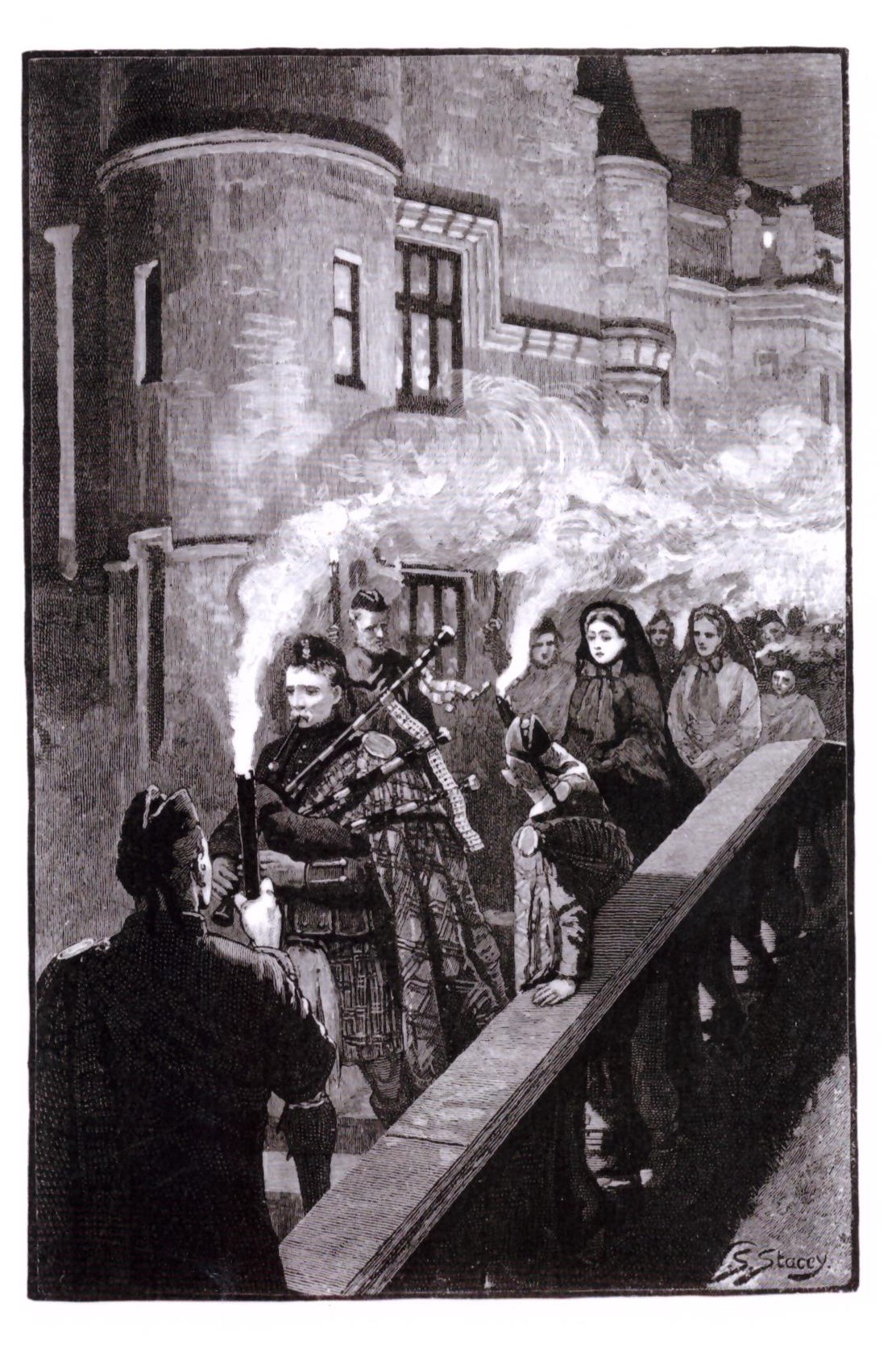
Queen Victoria following the piper ‘Got out & walked round the house preceded by the 2 Pipers, then a reel was danced round the bonfire of heaped up torches.’ Queen Victoria’s Journals, Monday 2nd November 1874. Credit: Sketch by S. Stacey, late nineteenth-century. Postcard in the author’s own collection
In subsequent years, as darkness began to fall on 31 October, the Queen would drive out from the castle in an open carriage carrying a lighted torch. She was followed by a procession of over 100 torch-bearing royal servants and tenants from the local farms with their families who were accompanied by a piper. At the front of the castle burned a huge bonfire made up of boxes and packing cases reserved throughout the year especially for that purpose. Next a servant dressed as a hobgoblin would appear pulling a cart which carried an effigy of a witch. The cart became known as ‘the shandry dann’ and this term later became synonymous with the witch herself. Spear-wielding fairies and the torch-bearers would gather around the fire to watch the goblin throw the witch to the flames, after which, reels were danced to the ‘stirring strains’ of Ross, the Queen’s piper. Sometimes matters got out of hand. In 1874 the celebrations were supposed to end with a dance in the ballroom but this plan was dropped when some the revellers behaved in ‘a rather disorderly manner’ at the bonfire!
Halloween at the castle became an event that many members of the Royal Family were loathe to miss. In 1873, the delicate prince Leopold was ‘rolled’ into the Queen’s bedroom, presumably in his sickbed, so that he could watch through the window. In 1877, the Queen wrote how she had hurried back from a drive to be in time for the parade and that her daughter Princess Louise walked at the side of her carriage carrying a torch and looking to the Queen ‘like one of the witches in Macbeth.’ So connected did Queen Victoria and her family become to the festivities at Balmoral that the occasion became dubbed locally as ‘Queen’s Halloween.’
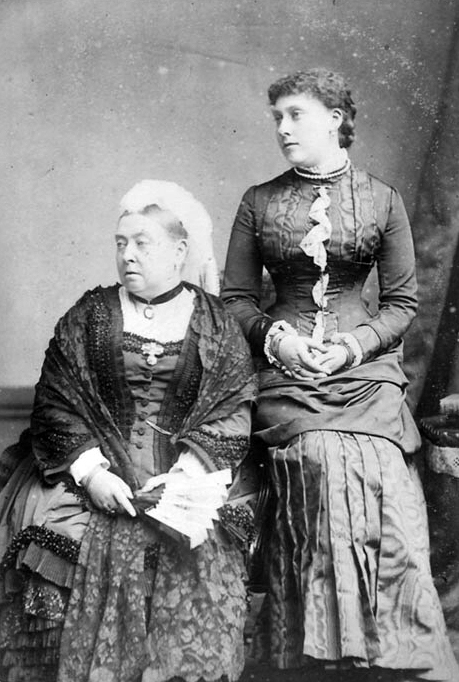
Queen Victoria and her daughter Princess Beatrice. Queen Victoria and her youngest daughter Beatrice with whom she often celebrated Halloween at Balmoral. This photograph was taken by Alexander Bassano (182901913). Credit: Wikimedia Commons.
Throughout the 1870s and 1880s, the Queen continued to celebrate Halloween with increasing – and what seemed to some almost dangerous – vigour: The Dundee Advertiser reported, how the usual burning of the witch had evolved into a rather sinister mock courtroom drama by 1881:
‘All being in readiness, a light was applied to the mass of combustibles by the hand of her Royal Highness the Princess Beatrice, and soon the flames roared and cracked, and rose above the highest of the Castle towers. On a given signal, a band of figures in masks, and wearing the most grotesque dresses imaginable issued from the mews of the Castle followed by a car in which was seated the effigy of a witch. The car was drawn by a hideous looking demon dressed in gaudy colours, and after several tours had been made around the bonfire, a formal Court was held by the company and the witch placed on trial. After the examination of one or two witnesses, the guilt of the witch was held to be clearly proved, and the judge pronounced sentence of death by burning. Immediately on the sentence being pronounced, the witch was dragged from the car and hurled into the flames, where she was speedily reduced to ashes amidst the shrieks and howls of the assembled ‘spirits.’ A witch hunt followed, and was the cause of much merriment.’ Dundee Advertiser 03/11/1881
It’s perhaps unsurprising that the Queen’s revelries on Halloween came to be heavily criticised, in the Press. First, it was, of course, considered unseemly, if not ungodly, for the Christian Queen of the British Empire, and Head of the Church of England at that, to be consorting with devils and demons. In The Bury and Norwich Post of 11th November 1879, an outraged journalist wrote that the spectacle seemed calculated ‘to foster rather than abate, a form of superstition which still has much hold on the ignorant in some parts of her Majesty’s dominions.’ Other papers saw humour in the Queen’s apparent obsession with evil spirits, with one remarking in 1882, that ‘the majestic-looking demon’ who figured in the festivities that year bore a marked resemblance to Prime Minister Gladstone (known to be no favourite of the Queen).
There was also another simpler reason why the festivities of the 31st October met with disapprobation in the English press; they were conducted in the Highlands of Scotland and thus very far away from the seat of government. The British public were increasingly concerned by the Queen’s frequently long sojourns at Balmoral, which, especially after the death of Prince Albert in 1862, could last for several months in the early summer and then again in the autumn. It is probable also that the criticism of the Queen’s activities on Halloween derived from the fact that they seemed to be greatly inspired by her association with John Brown, the Highland gillie, who appeared to many to occupy too much of her time and affection during her widowhood.
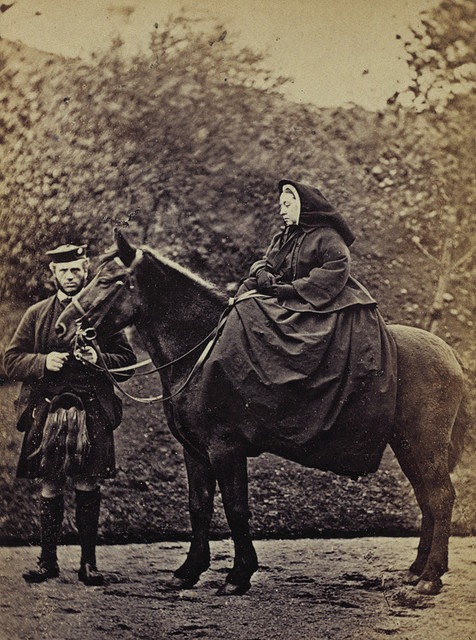
Queen Victoria and John Brown, Queen Victoria on her horse ‘Fyvie’ with gillie John Brown at Balmoral (1863), Credit: National Gallery of Scotland Commons, Wikimedia Commons.
Whether she was responding to public opinion, or merely melancholy at the death of John Brown in 1883, in the last years of her reign Queen Victoria no longer reported the occasion of Halloween in her Journal, the papers fell silent on the matter and autumnal celebrations at Balmoral appear to have tapered off. Either independently or as a result of the Queen’s declining interest, Scotland in general celebrated Halloween less fervently as the nineteenth-century gave way to the twentieth.
Further reading
Raymond Lamont Brown, John Brown: Queen Victoria’s Highland Servant, (The History Press, 2010).
Queen Victoria’s Journals Online http://www.queenvictoriasjournals.org/home.do
http://britishlibrary.typepad.co.uk/untoldlives/2013/10/queens-halloween.html#sthash.NDoJGvqC.dpuf Article on Queen Victoria and Halloween at Balmoral by Margaret Makepeace.
For Social History and Women’s History Books https://www.naomisymes.com/

Discover more from searchmyancestry - Ruth A. Symes
Subscribe to get the latest posts sent to your email.

Hi Ruth, What a well written and fascinating article this is. I really enjoyed reading it. I guess Queen Victoria celebrated Halloween more than bonfire night! Many thanks Graham xx
LikeLike
Love this article about my favourite historical figure. Informative and really easy to read. And a side of Queen Victoria that we don’t usually read about makes it really interesting. Looking forward to reading more articles by this talented author.
LikeLike
A most entertaining and informative article.
LikeLike