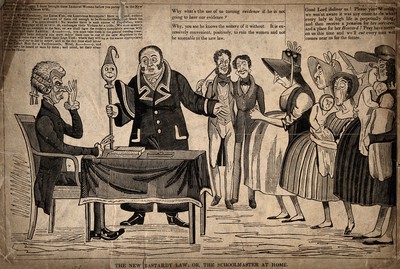
Unwed mothers being brought before a court room and treated severely. Woodcut. Wellcome images, in the public domain, undated.
Modern DNA techniques can now definitively solve questions of paternity, and can even resolve cases from several generations back in the past. But traditionally, there have been many other ways in which family historians could potentially discover who the daddy was when no father’s name appeared on birth certificates. Whilst these methods can never be as accurate as DNA testing, they can produce answers and in addition, tell us a great deal about how illegitimacy was viewed and dealt with in the past
A child whose parents were unmarried and whose mother had no obvious financial support was likely to become a financial drain on the local parish. Before the Poor Law Amendment Act (1834), the local Churchwarden or Overseer of the Poor (or in some cases Justices of the Peace at the Petty or Quarter Sessions) would conduct a verbal ‘examination’ of the mother to establish the identity of the father who would then be tracked down and put under pressure to maintain the child financially by entering into a Bastardy Bond.
Maintenance was expected to continue until the child was old enough to be apprenticed out or otherwise employed. Those fathers who resisted this could be forced to pay by way of an Affiliation Order delivered by the Justices of the Peace at the Petty Sessions or Quarter Sessions. Punishment in the worst cases could involve a prison sentence. After 1834 parish officials became less active in bastardy cases and single mothers were largely expected to sort out the upkeep of their children themselves. Further bastardy legislation in 1844, 1868 and 1920 tweaked the law in favour sometimes of the mother and sometimes of the father, and kept the issue of child maintenance as high on the government’s list of priorities as it still is.
The relevant records held in local archives and County Record Offices (and located via the website of the National Archives www.nationalarchives.org) include: The Bastardy Examination, Bastardy Warrants And Summons, Bastardy Orders, Affiliation Orders, Maintenance Orders and Bastardy Bonds. Take a look also at the Overseer of the Poor Accounts and Churchwarden’s Accounts for the local area at the time in question which are particularly interesting in cases of disputed paternity.
Family History Research Services.
Discover more from searchmyancestry - Ruth A. Symes
Subscribe to get the latest posts sent to your email.


Leave a Reply