By Ruth A Symes
This article was first published in Discover Your Ancestors online periodical in 2024
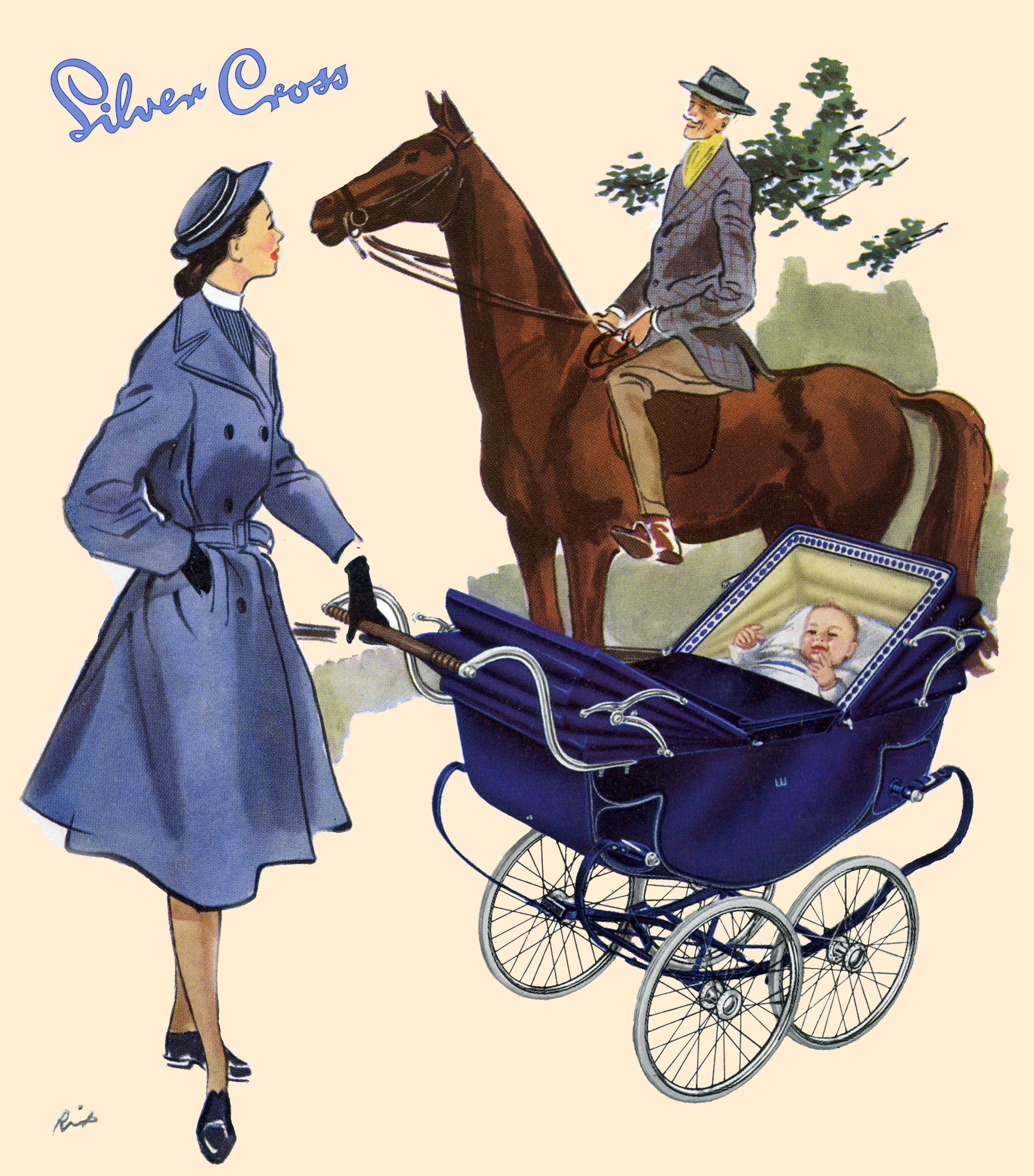
A Silver Cross coach-built pram with nanny. 1950s. Period pram advertisement from the British Pram Manufacturer Silver Cross. Via Wikimedia Commons
A smartly-dressed Mary Poppins pushing her shiny-wheeled pram is what most of us envisage when thinking about babyhood in the past. Such gleaming contraptions filled with smiling, bouncing tots seem an unlikely target for our ancestors’ displeasure, and yet newspapers reveal that early prams were the bane of life in some towns at the turn of the nineteenth and twentieth centuries. It’s hard to imagine the urban landscape at that time – a landscape still devoid of cars and even mostly of bicycles. No wonder then perhaps that some pedestrians were frustrated by the sudden appearance of thousands of ‘confounded chairs on wheels’ jostling for position in marketplaces and thoroughfares up and down the country.
Nowadays, just about every family has, at some point, had recourse to using a buggy of some sort, but in the early years of the pram, such vehicles were very much the privilege of upper and middle-class families and babies were often pushed about by maids or nannies rather than mothers. Many families remained too poor to own a pram well into the twentieth century, with the carrying of the youngest members of families by (often) numerous brothers and sisters being the norm. Whether or not one owned a pram was sometimes used as an indicator of social status. Indeed, in April 1911, this is how Hansard (in a report of a Parliamentary discussion of the Poor Law) described the poorest members of society:
‘There are children in the workhouses to-day…, who hardly ever know what it is to have a perambulator ride in a sunny lane, and who are removed from the joys of childhood, flowers and smiles, and kept up in the top stories of workhouses.’
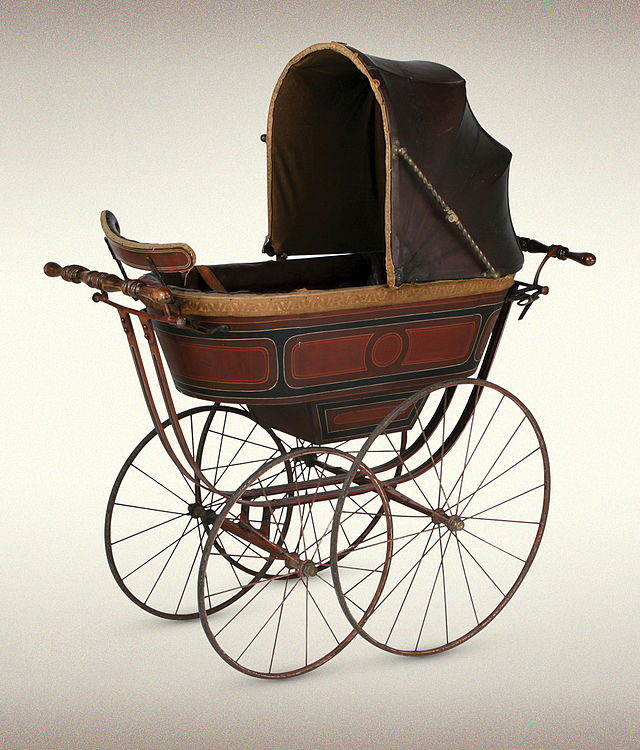
Silver Cross prams were first built by William Wilson of Hunslet, Leeds in 1877. The first prams included a ‘spring system’ and a reversible hood. Via Wikimedia Commons.
Nevertheless, for the higher classes, pram ownership was on the rise in the Victorian period, and there was evidently a growing frustration over the sheer number clogging up cities and towns – especially when they were using footpaths which hadn’t originally been built with their usage in mind.
In 1856, a poem in Punch lampooned the hapless young servant girls whom it considered unfit to be in charge of such heavy and unwieldy vehicles as perambulators:
‘Whilst you go blundering on with zig-zag course and wandering wits,
Probably your blessed babes are struggling in convulsive fits,
Not perceiving any object which is right before your nose,
Bolt ahead you drive your carriage on unhappy people’s toes.
Crushing corns and bunions so that those who watch your heedless path,
Will observe it marked by victims dancing mad with pain and wrath.’
‘Perambulators and Pedestrians or Mr Cross-Wig’s Annoyance.’
From Punch quoted in Reynold’s Newspaper, 27th July, 1856.
Many too were the sly digs at the mothers and nurses who had turned to prams to ease their daily domestic burden. An ‘indignant bachelor’ wrote to the Nottingham Journal 18th July 1858, ‘I do not see why the public should be inconvenienced because a number of mistresses choose to encourage the idleness of their nurserymaids by allowing them to use perambulators.’ In an effort to persuade pram-pushers to use the roads rather than the pavements, he went on, ‘If mothers will persist in using perambulators (which have been condemned by many medical men as injurious to the health of children riding therein) they ought to be compelled to pass along the carriageway, the same as any other vehicle.’
The tirade against women over their use of prams persisted. Rather than praising the help afforded to overburdened mothers and nannies by prams, the finger of blame was pointed at them for being lazy or inattentive to their children’s needs. ‘It is undoubtedly far more convenient for the mother or nurse to propel a helpless child before her than to toil with it during the daily walk, or subdue her pace to accord with its first feeble steps, ’ seethed a journalist in the Airdrie, Coatbridge, Bathgate and Wishaw Advertiser on 18th August 1866.
In some places, local byelaws did indeed, require that prams be kept off footpaths. This led to arrests and, unsurprisingly, to confrontation. In one case, in Hull, a servant girl pushing a pram (which ‘took up nearly the whole of the flags’) was forcibly taken to a police station by a very unsympathetic constable. A witness, upset by the way in which the policemen handled the girl, said that he had ‘never seen a girl so cruelly used.’ The accused ‘clung to every door jamb she could get hold of’ and was apparently pushed along ‘like a drunken woman’ by the policeman. There was additional general outrage that the girl had had to abandon the two children aged two and four who were riding in the pram in order to pay for her ‘crime.’ Hull Packet, 15th May 1868.
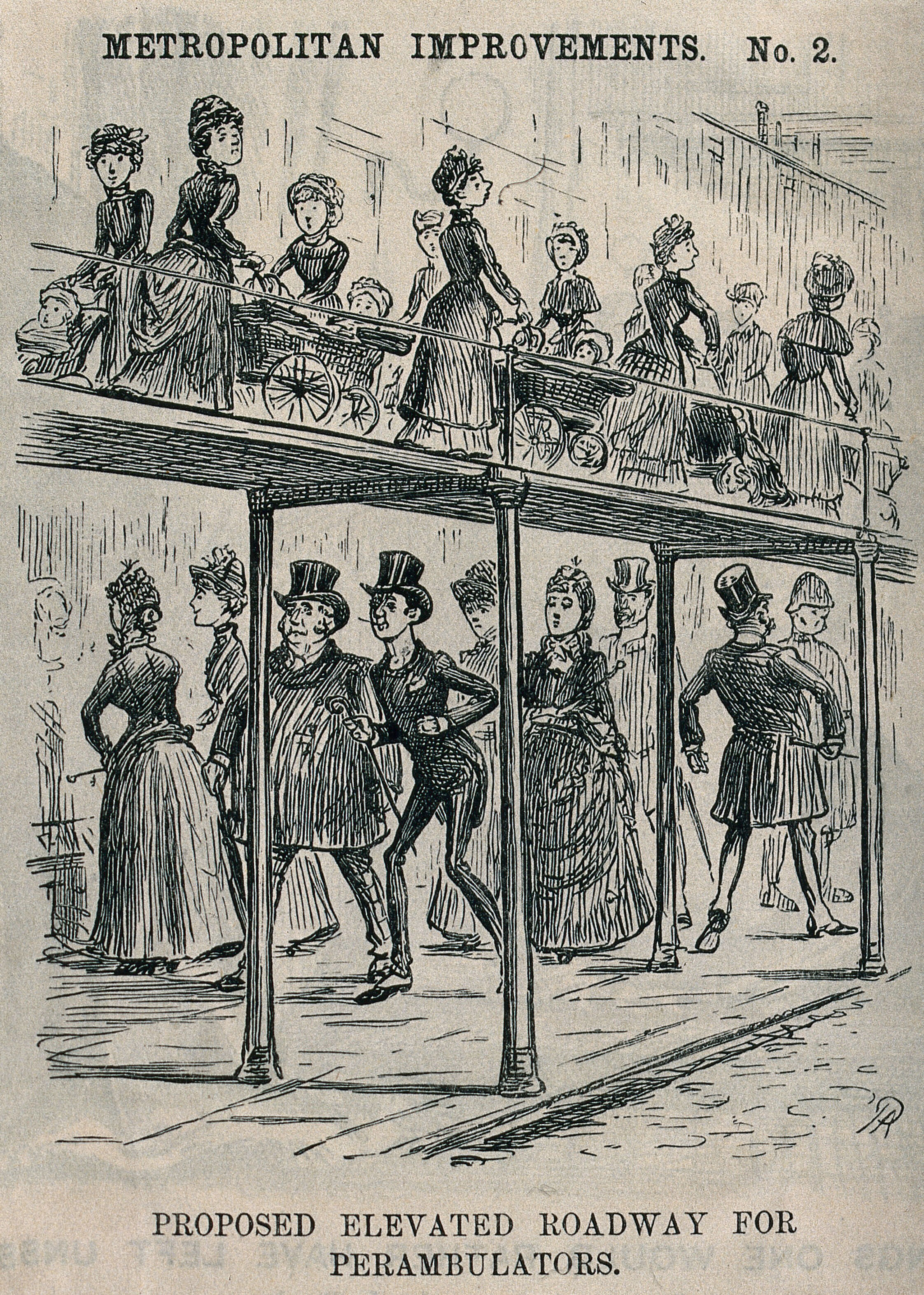
‘Metropolitan Improvements: Proposed Elevated Roadway for Perambulators’ Wood Engraving Punch 1885, via Wellcome Collection.Unfortunately, as pram design improved and prams became more affordable, the antagonism they generated only became exacerbated. From the 1880s, families gained the option of having their babies facing either towards or away from the person pushing, and pram wheels started to have more manoeuvrability. Town centres suddenly seemed to swarm with ‘babies in .’ To address the problem, Punch, rather facetiously, proposed an elevated walkway in city centres to accommodate those pushing prams.
It seems that any and every objection about prams that could be raised was raised in these early years of their popularity. Some argued that babies would become enfeebled by their reliance upon them since they would no longer be compelled to walk at an early age. By being exposed to wind, rain and the cold rather than the warmth of their mother’s breast, it was suggested that a child might become prone to more illnesses. A letter to the Leeds Mercury on November 18th, 1862, from ‘An Observant Mother’ went even further noting that babies in prams were subject to ‘unmerciful jolting and exposure’ which produced an unhealthy ‘excitement of the nervous system and brain.’ All these medical problems were of course aggravated by the fact that middle-class babies were now being pushed in prams by ‘young and incompetent nursemaids’ who ‘rattle the children along ….frequently at the peril of life and limb.’
Pushed by the wrong sorts ie ‘lazy,’ ‘dawdling’ and ‘addleheaded’ maids, prams took the blame for a range of other social ills troubling policemen up and down the country. Prams could, for example, become useful accessories to crime; their wheels provided a quick getaway, their deep baskets a repository for stolen items. Policemen frequently apprehended suspicious-looking pram pushers only to find items of clothing, boots, jewellery and other plunder tucked away under the blankets. On the other hand, and equally aggravating for the police, items such as rugs, clothing and toys, were often taken from prams by opportunist thieves.
Moreover, because prams were fairly expensive items that had occasionally to be left unattended outside shops and other public buildings, they were themselves very vulnerable to theft. Newspapers from the past are full of accounts of prams being stolen by chancers, often young girls as a prank, but also by other more conniving individuals who saw the potential for selling them and making some easy money. The Dundee Courier and Argos of 24th April, 1882 stated that a ‘valuable perambulator’ had been stolen from a shop doorway in Murray Street, Montrose and that, ‘it is supposed that the thief had[sic] mounted upon it and rapidly whirled off.’
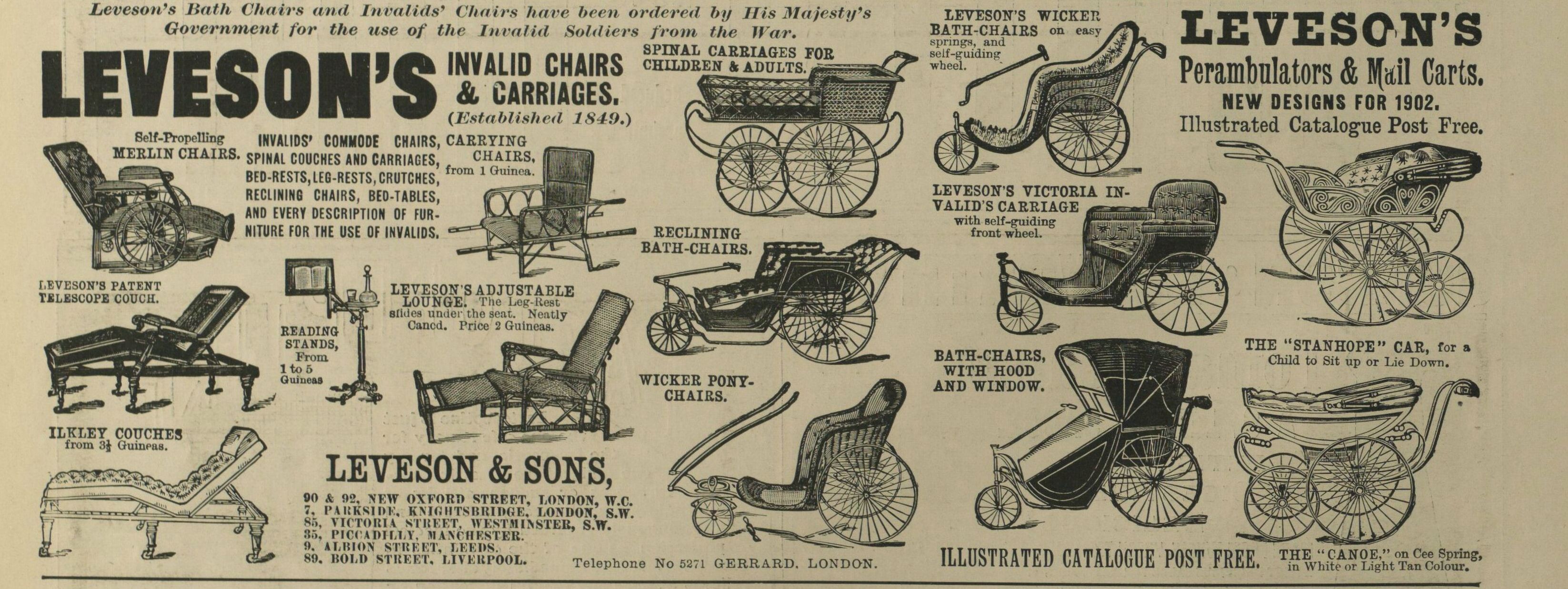
In 1902, the company Leveson’s was offering several different pram designs amongst other wheeled vehicles suggested for the use of injured soldiers returning from the Boer War. London Illustrated News, 5th July, 1902.
As time went on, more and more people from lower down the social scale came to be able to afford prams. Even then, commentators found something to grumble about. In 1894 a local journalist, Austen, writing for the Northwich Guardian expressed his outrage at the number of prams circulating around his local marketplace and his nostalgia for earlier times. It would be ‘a beautiful sight,’ he opined, to see English mothers carrying their babies in their arms as ‘they used to do.’ And he went on caustically to forsee serious social consequences as a result of pram use, ‘the next generation of men and women will have high notions, having been driven about in miniature carriages in their childhood.’
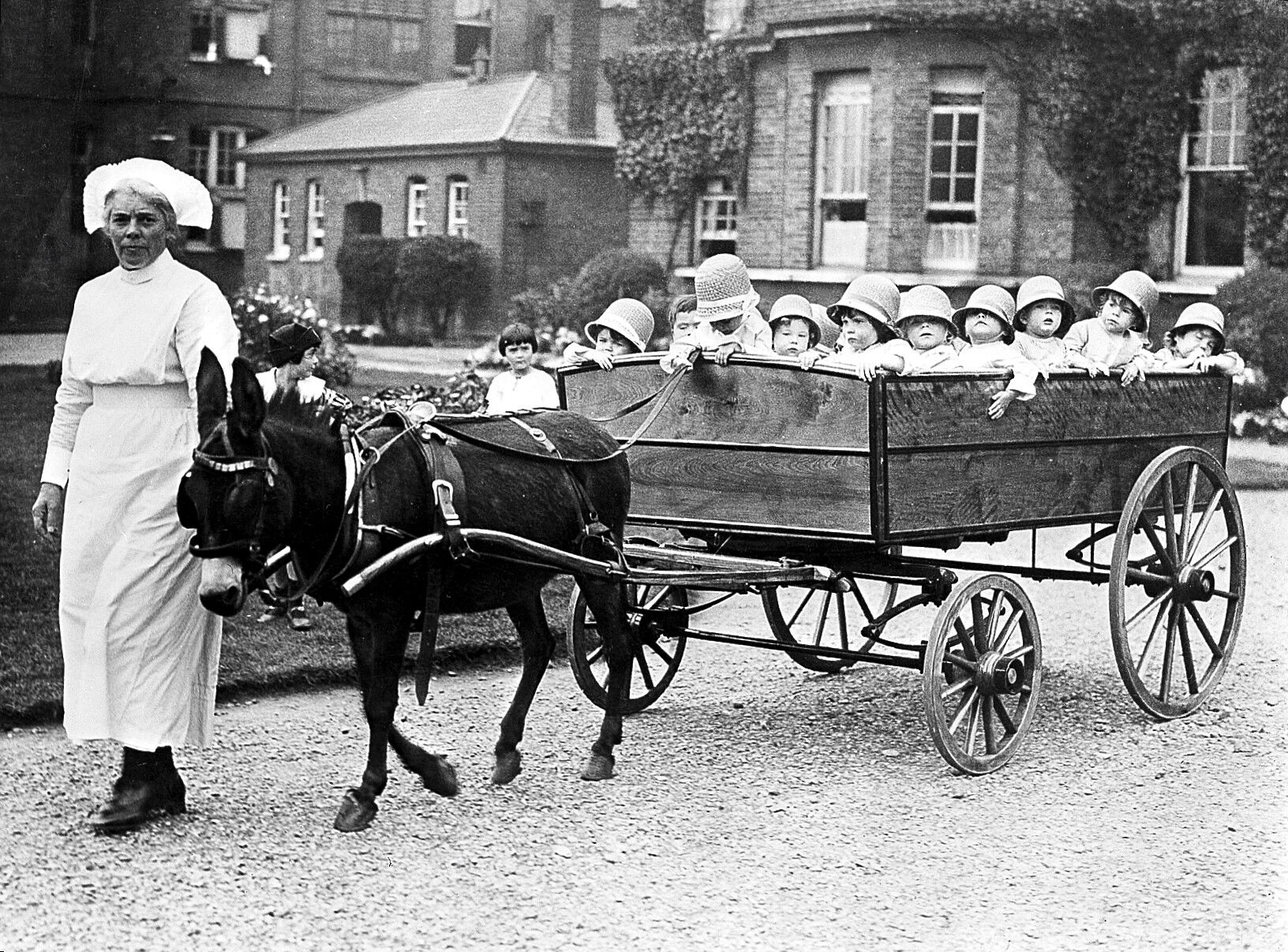
The 18-seater pram: a thrill for the children at Park Royal Hospital, Willesden. Morning Post, 19th August 1925. Via Wellcome Collection.
In a world where roads were still dominated by horse-drawn vehicles driven mainly by men, the appearance of a multitude of wheeled metal contrivances pushed by women seemed disproportionately to confuse and enrage the general populace. Looking back from our less misogynist twenty-first century perspective, we should perhaps perceive the pram differently. For many tired mothers and servant girls, the humble, engineless vehicle must have been a huge time and energy saver. The snipings of journalists aside, prams were undoubtedly an early boon in a long line of devices that would gradually set women on the road to emancipation from domestic servitude.
Find Out More
Janet Rawnsley, The British Pram, Jeremy Mills Publishing, 2018
Jan and Geoff Swift, Prams in the Garden A Pictorial History of the British Perambulator, Jan and Geoff Swift, 2015.
Vintage Baby Carriages of Bygone Times – 5-Minute History (fiveminutehistory.com) An attractive illustrated timeline of the history of prams.
Family History Research Services.
Buy My Books
Subscribe
About Ruth A. Symes
Discover more from searchmyancestry - Ruth A. Symes
Subscribe to get the latest posts sent to your email.


Thank you Ruth a really interesting article. I never knew the seemingly harmless prams of today caused so much controversy in the past.
LikeLike