By Ruth A Symes
This article was first published in Discover Your Ancestors Online Periodical in 2025.
http://www.discoveryourancestors.co.uk
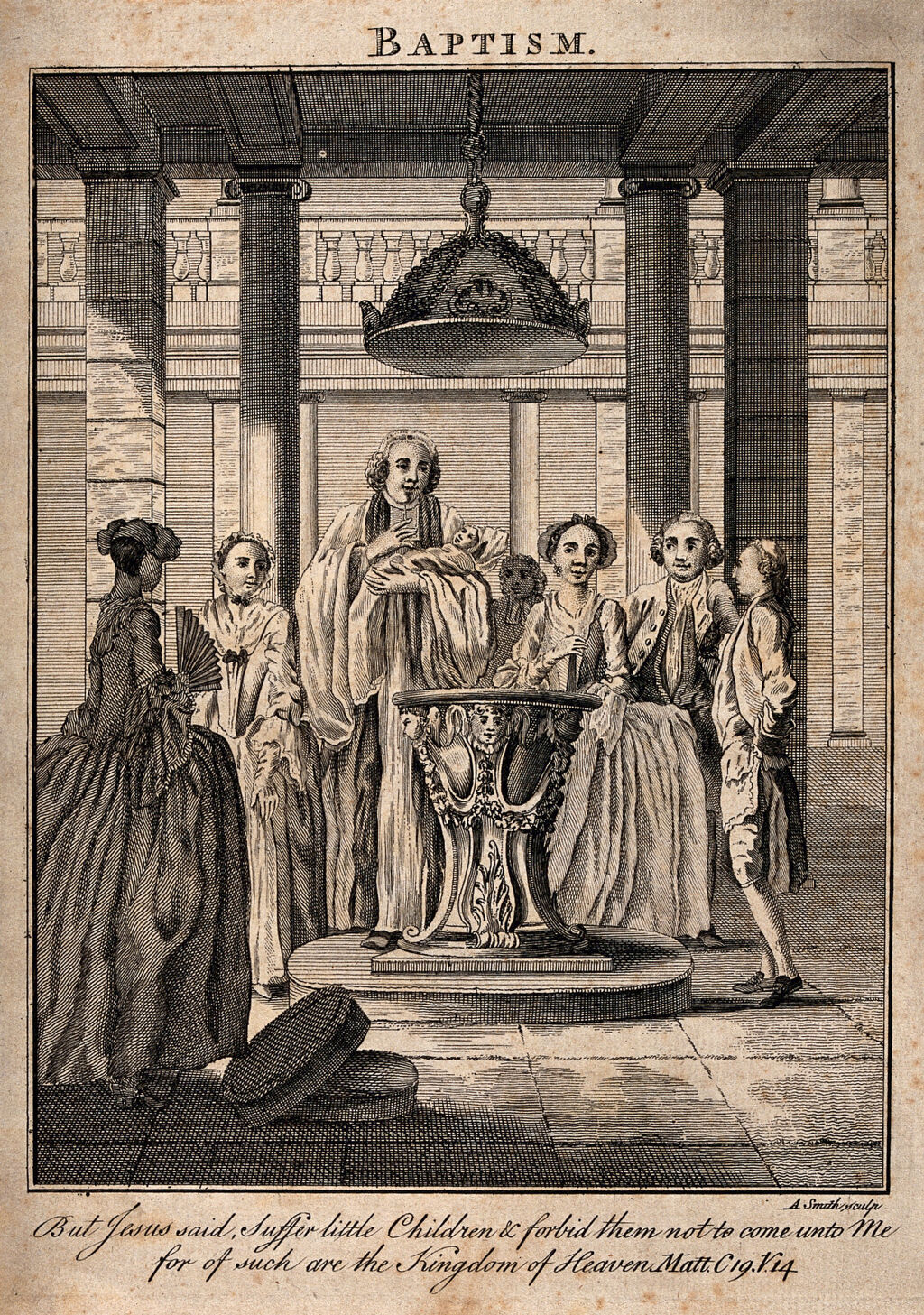
Etching of a baptism by Anker Smith (1759-1819), Wellcome Collection.
Like marriages and burials, baptisms were key life events by which our ancestors demarcated their life experience and for which our extended families in the past routinely gathered. Though the baptisms of most of our ordinary nineteenth-century ancestors didn’t make their way into the newspapers, editors were quick to report any services that presented unusual, dramatic or comedic moments. The reading public certainly liked to be entertained with accounts of ceremonies that, for one reason or another, deviated from the norm.
In the Midst of Life
It’s worth remembering that given the high child mortality rate in Victorian Britain, christenings could be tense events, especially in cases where very newborn babies in a fragile condition were brought to church in an effort to ensure that they were baptised before they died. A case in point, reported by several newspapers, was that of two day-old baby girls presented at a Roman Catholic Chapel in the Commercial Road, Wapping in January 1865. Their mother, a Mrs Knight, had given birth to triplets earlier that day, but the boy had unfortunately died immediately. She had, therefore, instructed a couple of neighbours to take the girls to church for baptism straightaway without consulting her husband (a lapsed Protestant). Mrs Connor and Mrs Clark were told to ‘make haste’ for fear that the girls would die and, in their unbaptised state, would not go to heaven. Sadly, when the girls were ‘unwrapped’ in the church, it became clear that one of them had in fact died. A doctor later expressed his horror that two such young babies had been hurried to church in such a manner commenting that ‘it was the most indiscreet thing possible to have taken the children through the streets immediately after birth on such a cold day.’

Portrait of woman with a baby in a christening gown, photographed by Roberts of Llandidrod Wells, (1890s to early twentieth century). Via Wikimedia Commons.
Baptisms of Ice, Water and Fire
The tools required by a baptising minister appeared to be simple and foolproof : simply a font and water. But, at Clyro on the Welsh Marches, on Sunday 13th February 1870, the Rev. Kilvert complained in his diary that the weather was so cold that he had had to baptise a baby in a font in which ice was floating! And, in 1886, in a church in South Leith, Edinburgh, a minister (who was about to baptise six infants) unfortunately ‘felt no water on his fingers.’ Thinking that he had not put his hand ‘deep enough into the baptismal bowl, he made another attempt to reach the water and this time also without success.’ On the third attempt, he went deeper and found that no water at all had been put into the font! It turned out that the ‘worthy beadle’ whose job it was to fill the font had been away the previous week and had forgotten to fulfil his duty. The congregation were fairly amused.
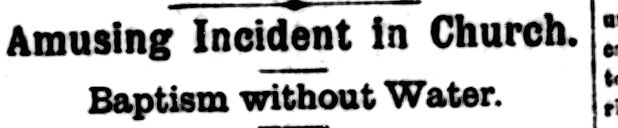
Newspapers picked up on any potentially amusing incidents within a church setting. Evening Gazette, Aberdeen, 28th August, 1888. Via http://www.findmypast.co.uk
Rather more dramatically, at St John’s Church, Moulsham, near Chelmsford in 1912, a baptism was interrupted when one of the adult participants erupted into flames! Mr A. Offley, the father of a baby boy about to be named ‘Lesley Walter,’ had a box of safety matches in his pocket which had, through friction, combusted with some ‘potash of sulphur tabloids’ that he was also carrying for a sore throat. Thankfully, the man was uninjured except for ‘a little about the hands, but, ‘his waistcoat and trousers suffered considerable damage’ and he was, unsurprisingly somewhat shocked.
Naming Nonsense
Time after time, despite the simplicity of the baptismal procedure, parents and godparents managed to get things wrong. A common mistake was for the godparent to give his or her own name to the minister rather than the name of the child to baptised. In 1892, The People’s Friend ran a long article covering a number of humorous stories around this issue. One of these was the discomfort of clergymen when presented with a name which for one reason or another they could not agree to. Examples given included ‘Pontius Pilate’, ‘Venus’ and ‘Napoleon Bonaparte’ (dismissed by one particular vicar to the church at large as ‘our enemy’)!
Usually, the baptising minster would ask that the name of the child be written on a piece of paper that would be handed to him at the font. On one occasion in Edinburgh in 1891, a man who had just become a father for the eleventh time (and who might therefore have been supposed to be fully conversant with the procedure), offered his hand to be shaken, rather than the slip of paper to the minister at the relevant moment. Evidently he thought he was to be congratulated for his productivity! The moment was greeted with ‘titters’ from the crowd.
At another Edinburgh church on the same Sunday, an inexperienced father forgot to take his piece of paper up to the front. Despite whispering the name of his child, ‘Murray,’ three times, he failed to make himself understood. The minister, who thought he was saying ‘Maggie’, was understandably confused since the child was male. A full disaster was finally averted when, after clumsily offering his child to the minister to hold whilst he finally retrieved the necessary piece of paper, the young father raised his voice sufficiently to be correctly heard.

Two babies who were christened simultaneously by the clergyman pictured at Sion Lodge, Ferrybank, Waterford, Ireland. One of these ladies is Mrs Augustus Smith, a member of the Waterford & South-East of Ireland Archaeological Society, c.1895. Via Wikimedia Commons.
Faltering Fathers
Babies were usually carried into their baptisms by their mothers or by some other female relative; this inevitably led to fathers feeling a little surplus to requirements. In 1904 (in another edition of The People’s Friend), a parish minister recounted watching numerous apprehensive fathers as they fretted on the edge of the service, nervous about standing up before the whole congregation, anxious as to whether or not the child would arrive on time, and whether it would yell throughout the service. In the minister’s opinion, fathers were always desperate for the service to commence, and would march up to the font at the appointed time in a number of different (but always inappropriate) ways: with quick and agile steps, solemn and stately, or ‘as if to their doom.’ Unused to the formality of church, which they might not have attended since their wedding day, fathers were sometimes ‘given a nudge’ by the beadle for standing with their hands deep in their pockets or for’ leaning leisurely on the choir rails as if surveying a field of oats.’
One ancient piece of superstition that lingered long into the nineteenth century. was that the boys presented for baptism at the font should be named before the girls. In Edinburgh in 1896, the shy father of a baby boy hid amongst the congregation and had to be coaxed to come forward to see his son receive his name. This meant that a baby girl, who was also to be baptised at the same service, received her name before he did – a most untoward circumstance and one which was popularly believed to bring bad luck to both youngsters.

Crying at a baptism was popularly considered to be a sign that the baby was expelling its natural inner evil. Those babies who didn’t cry were thought to be too good for this world, and were therefore expected not to live long. Weeping Baby – Sir C. Bell, The Anatomy and Philosophy of Expression as Connected with the Fine Arts. London: John Murray, 1844, p. 155. Welcome Institute.
Minister versus Congregation
Just as at weddings and funerals, there was always room for confusion (and therefore humour) at a baptism in dealings between the literate and highly educated officiating minister and the ordinary church folk. The Chester Chronicle of 1882 records an amusing misunderstanding between a mother and vicar as the baptismal certificate was being signed in the registry after the ceremony. Referring to the date, the vicar said, ‘Let me see, this is the thirtieth.’ ‘Thirtieth!’ replied the ‘indignant mother’ thinking that he was referring to the number of children she had had, ‘indeed, it is only the eleventh !’

A particularly beautiful Norman baptismal font in St Peter’s Parish church, Tickencote, Rutland, ornamented with interlaced arches. Via Wikimedia Commons.
Dropping the Baby
Of course, the most distressing incident that could happen at a baptism was if the vicar or any of the participants mishandled, or worse still, dropped the baby. Thankfully reports of such incidents appear thin on the ground in British newspapers, but many recounted the extraordinary moment in Holgate, USA in 1897 when the (aptly named) Rev. Mr Fish was about to perform the sacrament of baptism on the daughter of a Mr and Mrs John Wright. ‘As the minister was about to lower his candidate into the water, he was struck by something which the doctors cannot explain, and dropped the lady into the water. Deacon Bowers rushed forward, raising the lady, who nearly drowned.’ Whatever the reason for this incident, the service was not completed and the little girl remained, for the time being, unbaptised.
Much as in sitcoms and comedy sketches today, untoward happenings at baptisms, marriages and funerals provided an unending source of ghoulish fascination and outright delight for our ancestors through the medium of local and national newspapers. Meant of course to be solemn occasions, these vital events were always tinged with the ever-present possibility of humorous accident or imminent disaster – something which has always kept congregations on the edge of their pews and which will, no doubt, continue to do so.
Family History Research Services.
Discover more from searchmyancestry - Ruth A. Symes
Subscribe to get the latest posts sent to your email.
 searchmyancestry - Ruth A. Symes
Leave a comment