By Ruth A Symes
This article appeared in Discover Your Ancestors online periodical in 2025.
Discover Your Ancestors | Bringing Past Lives to Life
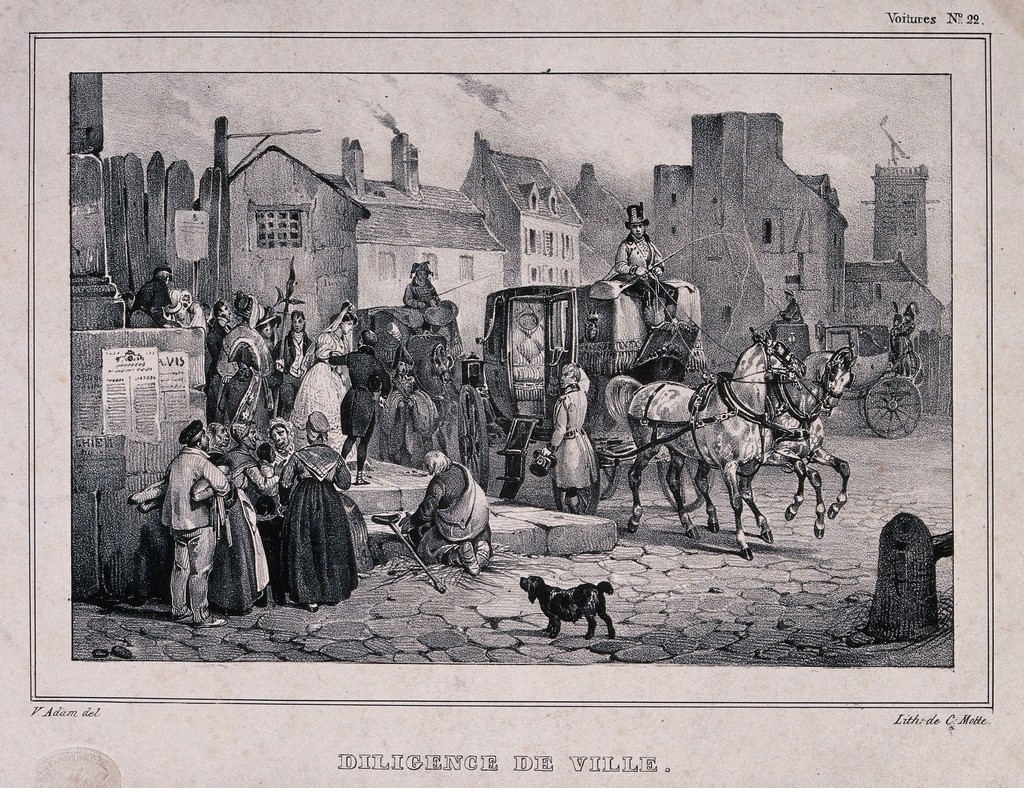
A horse-drawn carriage arrives at a church in a poor part of a town: a newly- wed couple walk down the steps towards it as the coachman holds the door open and spectators stand by. Lithograph by C. Motte after V. Adam, 1828. Via The Wellcome Institute.
The history of matrimony is full of enough bloopers, gaffes and mix-ups to furnish a modern day sit-com with endless storylines. Even before newspapers took ordinary announcements of marriage as a matter of course, their pages teemed with humorous and dramatic accounts of nuptials that for one reason or another didn’t happen, or almost didn’t happen. Even if your ancestors’ wedding itself doesn’t appear in print, you can get an idea of the concerns that inevitably surrounded every couple’s big day by perusing historical newspapers online.
No-Shows
In the past, just as nowadays, brides and grooms occasionally got cold feet. In Roystone near Barnsley in 1874, Miss Mary Battison waited and waited for her fiancé, Mr Uttley, to turn up at the church but to no avail. It became apparent that the ‘fickle’ fellow had ‘decamped’ taking with him a borrowed watch and a suit that he had bought on credit for the occasion. In a valiant attempt to save the bride from embarrassment, another young man from the neighbourhood, a ‘sinker’ from the nearby colliery, suggested that he would willingly take the place of the missing groom. This, rather surprisingly, was acceptable to the bride and her mother who enquired of the vicar whether it was possible. On discovering that the match couldn’t be made that day, the new prospective groom suggested that guests help themselves to the excellent wedding dinner served at the nearby Hope and Anchor public house with the bride’s mother stumping up the money for liquor. It was agreed that a second marriage should be arranged as soon as possible. Sheffield Daily Telegraph August 1st 1874.
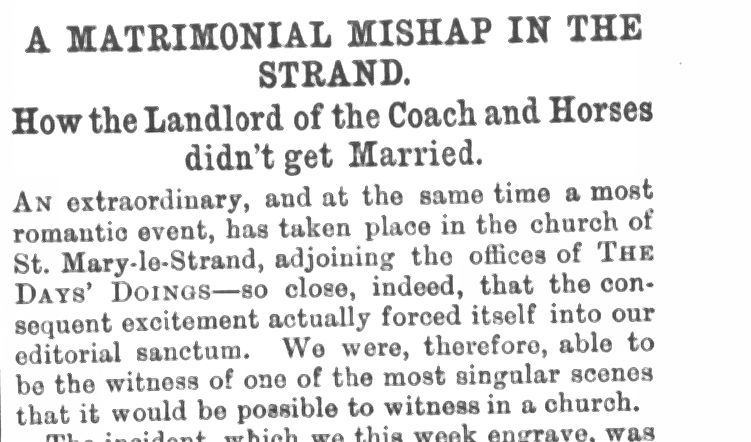
Many dramatic headlines in newspapers came about because of unexpected happenings at weddings!The Day’s Doings, December 3rd, 1870, The British Newspaper Archive via FindmyPast.
Not all brides were victims or push-overs. In 1870, a Miss Andersen of the Haunch of Venison public house, Bell Yard, Fleet Street was about to marry Mr Parfitt, the landlord of the Coach and Horses in the Strand. When the officiating clergyman asked the bride, ‘Will you have this man to be your lawful wedded husband?’ Her unexpected reply was, ‘No, I will not’ and she ‘immediately turned on her heel and flounced out of the church.’ Instead of then getting into the marriage brougham, the bride got into an ordinary four-wheeled cab and made her way home. The reason for this state of affairs seems to have been pure revenge. The wedding had originally been set for an earlier date but had been cancelled at short notice when the groom changed his mind. The bride’s family had then persuaded him to honour his original proposal and the wedding was rearranged. Evidently, the bride had not forgiven him!
Sometimes, it was not the married couple, but the officiating clergy who failed to show up. In Leamington in January 1893, a young couple waited for an hour and a half for a vicar. Eventually the clerk was called upon to see what he could do. Fortunately on leaving the church, he bumped into a local vicar who was passing by. The Rev Flory quickly put on a surplice (which he found in the vestry but which was unfortunately too short), he was then thankfully able to marry ‘the chilled and somewhat woebegone pair’ without further ado.
Slip Ups During the Service
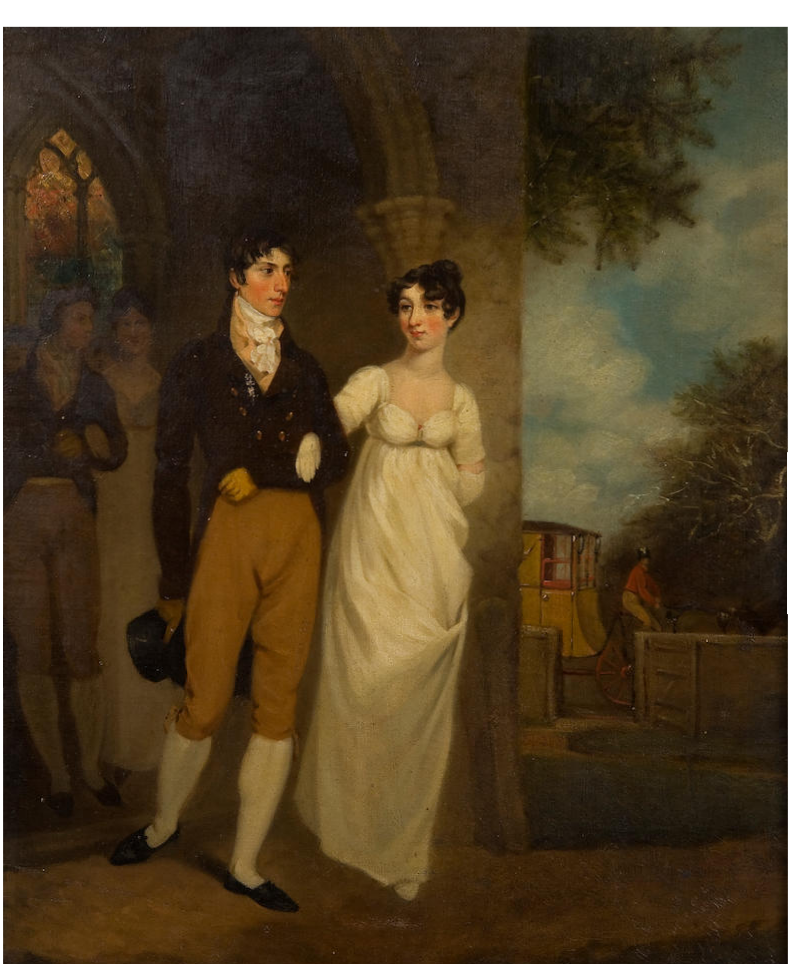
Thomas Clover and his bride on their wedding day in the porch of Thwaite church. Painted by the groom’s brother Joseph Clover. Undated. Via Wikimedia Commons.
Marrying couples were often woefully ignorant of the protocol to be followed during the marriage service – sometimes with disastrous results. In Langport, Somerset, in April 1899, a vicar inadvertently married the bridegroom to his own sister after the bride mistakenly sat down with the witnesses. In Stokesley, North Yorkshire, in 1879, a groom and bridesmaid arrived at the church together having had far too much to drink. With the whole wedding party apparently blind to the fact that the bride herself had not yet arrived, the vicar began the proceedings and the groom declared himself willing to be married to the woman by his side. At this point, the bridesmaid came to her senses and remembered that this was her sister’s big day and not her own. The vicar declared that if the groom was ‘too intoxicated to distinguish the bride from her sister […] he was not in a fit and proper state to be married,’ and he declared the wedding off.
In a blunder in Brierly Hill in the Black Country at a wedding in 1891, the groom handed the wedding ring to the best man who then answered the vicar’s questions as if he were the groom. This unfortunate state of affairs resulted in the best man being married to the bride (he being also her sister’s boyfriend). Such was the deference of ordinary people towards the socially superior vicar, that nobody rectified the error for some time. We are told that, ‘the bride herself had some idea that the proceedings were hardly as they should be, but did not remonstrate!’
For many working-class couples, getting married was the only time in their lives when they were required to speak publicly and formally. Many had little education and their only knowledge of the wording of the marriage service came from their memories of having heard it before at the marriages of others. One clergyman recounted that in his parish, “it was quite the fashion for the man, when giving the ring, to say to the woman, ‘With my body, I thee wash up. And with all my hurdle goods, I thee and thou.’” Women were apparently better at remembering this part of the service than men but the same vicar had been startled to hear a woman “promising, in what she supposed to be the language of the Prayer book, ‘to ‘ave and to ‘old from this day fortni’t, for betterer horse, for richerer power, in siggeress health, to love cherries and to bay.’ What meaning this extraordinary vow conveyed to the woman’s own mind, the incumbent said, it baffled him to conjecture.” Liverpool Weekly Courier, 23rd July, 1898.
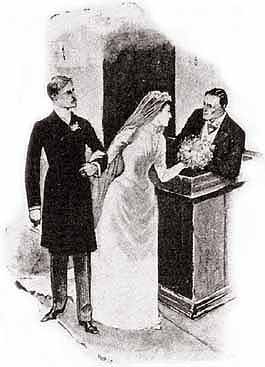
There was always the possibility of unusual involvement from the congregation at a wedding. ‘The gentleman in the pew handed it to her.’ Illustration by Sidney Paget to the Sherlock Holmes short story, ‘The Noble Bachelor’ in the Strand Magazine, April, 1892. Via Wikimedia Commons.
It was one thing for the couple to get their words mixed up, but it was quite another for the officiating clergy to make a linguistic gaffe. Thus, the guests at the wedding of the Venerable H.W. Watkins, Archdeacon and Canon of Durham and Miss Kate Thompson, daughter of Sir Henry Thompson, in 1883, were horrified to hear a member of the clergy reverse a well-known maxim when he pronounced, ‘These whom God hath joined asunder let no man put together.’ Thankfully the mistake was corrected with ‘much quiet tact’ and that part of the proceedings repeated correctly. The Weekly Irish Times, Saturday July 14th, 1883.
In general, the taking of marriage vows required a degree of solemnity that was sometimes at odds with the mood of the guests. In Houghton-le-Spring, Sunderland, in 1839, a rather humourless member of the clergy halted a wedding because the bride and groom (and then the whole congregation) were laughing too much. The mirth arose from the fact that the happy couple had held out their left rather than their right hands when asked to hold hands. Why this had occasioned such merriment can only be guessed at, but it was enough to delay the nuptials to another day.
Procedural Problems
Sadly, even if all the actors present at the wedding were on time, willing and word perfect, marriage ceremonies could still unravel because of a failure to follow procedure.
If the names of the key participants had been incorrectly submitted to the clergy in advance of the wedding, they could not be changed on the day. A wedding in Barnard Castle, County Durham, in 1846, for example, was postponed because when the ‘bride-elect’ came forward to the altar, she “blushed and simpered, ‘Please, sir, my name’s not Mary it’s Margaret.’’’ The young woman was then ‘forced to remain three weeks longer a spinster… through the blunder of a parish clerk.’
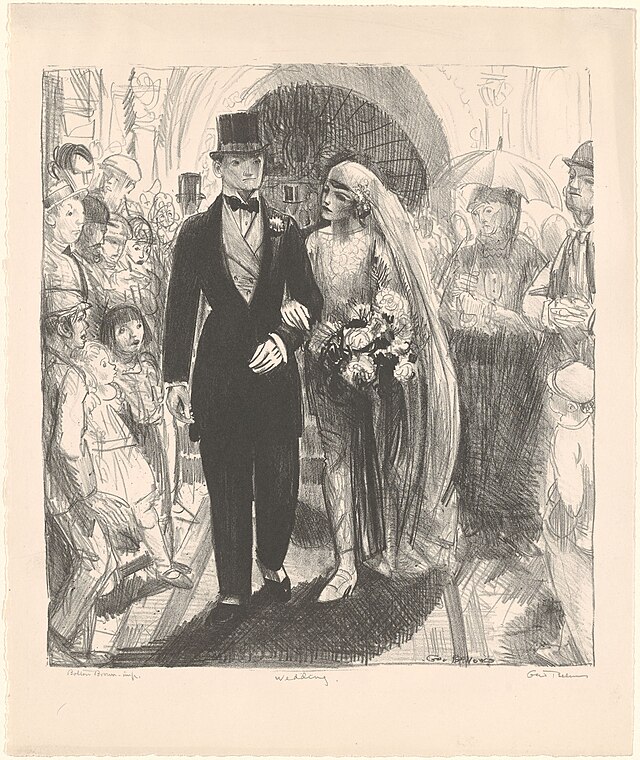
‘Wedding,’ possibly inspired by a photograph of a society wedding in a newspaper. Lithograph by George Bellows c 1923 via Wikimedia Commons
When procedure wasn’t followed, whole congregations could end up embarrassed. The requirement to obtain a marriage licence for weddings taking place at short notice caused abundant problems. In Blackburn in 1863, a groom, ‘an ensign of our local rifle volunteers’ forgot to obtain such a licence. Despite rushing ‘pale and trembling’ to a telegram station to message the Secretary of the Lord Bishop of Manchester, he was told no licence was obtainable that day.. Great discomfiture unsurprisingly then ensued amongst the wedding guests. One, ‘a stout, robust, rubicund relative of the bride, tore the wedding favour from his breast and wished himself at home unseen, ungazed upon. This was most likely the secret wish of all’ …. Thankfully, the groom was able to take a train to Manchester later that day and to obtain the licence. The marriage went ahead at St Paul’s Church the next morning without further ado.
Another regular procedural issue was the matter of the bride’s (or sometimes the groom’s address). At one wedding in York in the autumn of 1883, a marriage had to be postponed when it was discovered that the rules of residency – which compelled a bride to have lived in the parish where she was marrying for at least three weeks prior to her wedding – had not been complied with. Despite a large congregation having turned up at an occasion that was ‘as merry as a marriage bell’, the proceedings had to be halted much to the amusement of the gathered congregation and to the bride and bridegroom’s ‘indescribable annoyance.’
Newspapers from the past teem with stories of relatable human wedding disasters describing at length numerous other stumbling blocks to smooth-running nuptials. Far more weddings than one might suppose were stopped (as famously in Jane Eyre) when a member of the congregation stood up to speak of some ‘just impediment’ – a previous wife still living perhaps, a consanguineous relationship between the two parties, or an participant who was under the legal age for marriage. And there were other, less dramatic reasons for weddings being postponed or delayed: everything from misplaced or dropped wedding rings, to registrars that didn’t turn up, and chapels that turned out to be unconsecrated for worship and therefore not licensed for marriage.
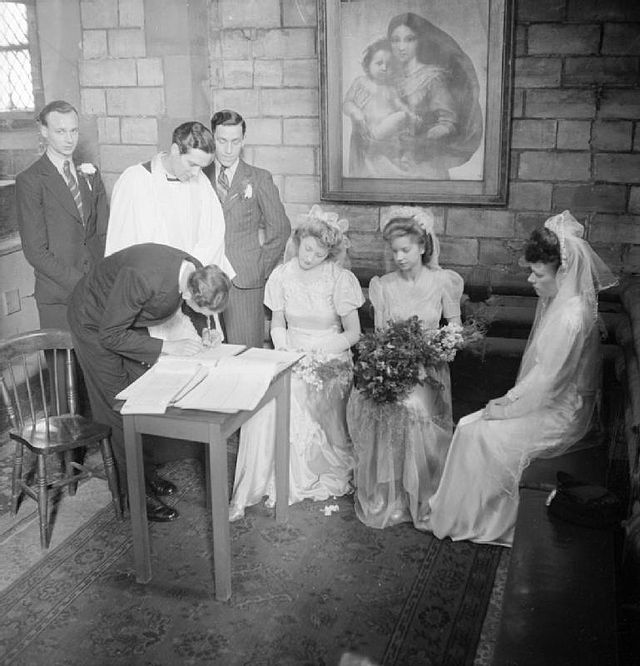
Unusual marriages have always made the papers. At this one in 1944, the vicar of St Mark’s Church, Victoria Docks, Silverton, London simultaneously married three brides and three grooms. Via Wikimedia Commons.
Given all the calamities that might possibly have befallen them, we should perhaps be thankful when we do locate a family marriage certificate that our ancestors actually managed to tie the knot at all!
Family History Research Services.
Discover more from searchmyancestry - Ruth A. Symes
Subscribe to get the latest posts sent to your email.

Leave a comment