By Ruth A Symes
This article was first published in Discover Your Ancestors online periodical in 2025
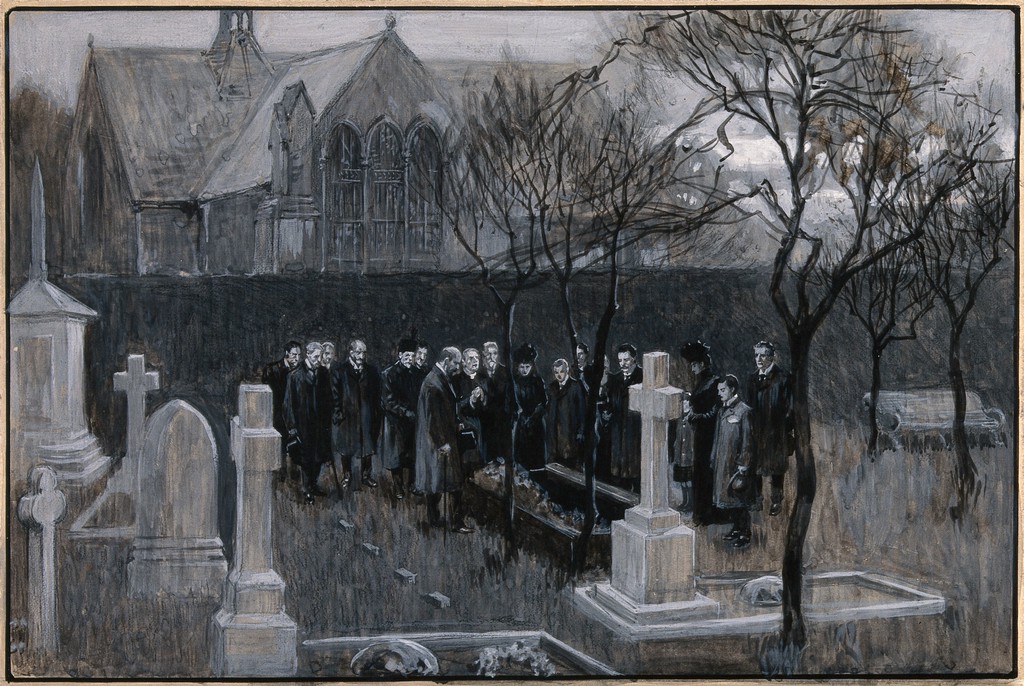
The funeral of Sir Hector Macdonald in Edinburgh, 1903 by F. C Dickinson after J. Faulds. Macdonald had supposedly committed suicide after allegations of homosexuality and paedophilia were made against him. Later some claimed that the coffin had been empty and that he had started a new life abroad. Via Wikimedia Commons.
When researching our ancestors deaths in the nineteenth century, most of won’t get any further than a death certificate. Ordinary deaths were not recorded in newspapers, and funeral notices and write-ups were generally only made for important people. Nevertheless, some funerals did make the news – and dramatic news at that – when they involved unforeseen problems and worse.
Matters of Death and Life
Local newspapers revelled in describing ‘Painful Incidents’ that had occurred at funerals. The most dramatic were those which involved another death at the graveside. Severe grief could bring on fatal medical conditions as was the case at Ford Roman Catholic Cemetery near Liverpool in June 1886, where the eldest son of the deceased Mrs King, ‘sighed and fell in a faint.’ He was removed from the scene and medical attention was summoned but he never recovered consciousness. There were also all too many occasions when pall bearers, who had carried the heavy weight of a coffin over some distance, collapsed, and in some cases expired, soon after relinquishing their burden.
A particularly shocking death at a funeral occurred in 1872 at Kensal Green Cemetery, North West London when the parish clerk, Henry Taylor, caught his foot against a side stone, stumbled and fell at the graveside. In the confusion, the coffin (a particularly heavy one made of lead) was dropped and it fell onto Taylor. Unsurprisingly, the already grieving widow went into hysterics. The unfortunate clerk suffered a fractured jaw and ribs and later died from bronchitis brought on by his injuries. After this incident, a jury recommended that straps should always be placed around coffins to prevent such a thing happening again. The event was noteworthy enough to make newspapers across the country accompanied by a vivid drawing of the incident.
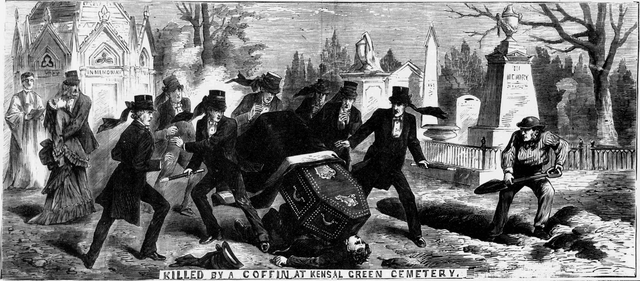
An (unknown) artist’s impression of the unfortunate event at Kensal Green Cemetery on October 19th, 1872 that led to the death of Henry Taylor. Via Wikimedia Commons.
Almost unbelievably, the intense emotions experienced at a funeral occasionally brought on births as well as deaths. In Deane Churchyard, Bolton in February 1872, a baby was born to a woman minutes after she left the conveyance that had taken her to the churchyard. She had been attending the funeral of her brother who had committed suicide.
Body Blunders
Most stories about people mistakenly ‘coffined alive’ were about funerals on the Continent or as far away as South America. There was always a hidden undertone of xenophobia here, the idea that medical and funeral services in other countries were far inferior to (and less careful than) those in Britain. But occasionally, cases of living people being mistakenly buried did occur at home. In 1890, the 40-year old wife of John Korb of Middlesborough was ‘to all appearances dead after a long period of sickness’. But as her coffin was carried from the church, noises could be heard within. On the removal of the lid, the woman was found to be alive, too weak to speak and evidently frightened by her situation. When Mrs Korb opened her eyes, the female mourners ‘screamed and ran about as if demented’ and many of the men ‘lost their presence of mind’. The saga continued when Mrs Korb went on to sit up in her coffin. Eventually, the poor woman was taken into the church and medical assistance sought. Sadly, she fell back dead within a short while.
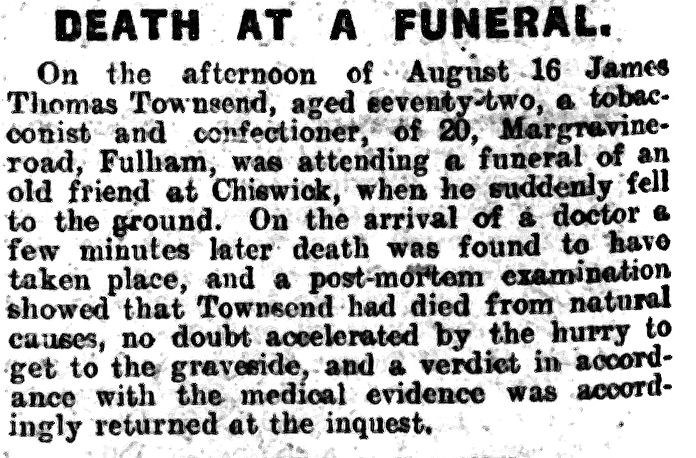
Item recounting a death at a funeral from the Illustrated Police News August 29th, 1920. British Newspaper Archive via FindmyPast
In another case in Gunnislake in Cornwall in 1892, a baby was buried in the arms of its deceased mother. During the preparations for the funeral, the father was astounded to hear crying coming from inside the coffin. The box was duly opened and the baby found to be still alive. Later that day, the baby was once again pronounced dead but the doctor advised that it be wrapped in blankets for a few days just to make sure that it was actually deceased. This case provoked calls for the Registrar General to make it compulsory for a doctor to see a body before pronouncing it dead.
Blunders with corpses always made for dramatic reading fodder in newspapers. In Cashel, Tipperary in 1885, the lid of a coffin slipped aside as it was being lowered into the grave, revealing that it was empty. Further drama ensued when the gathered crowd turned to see an old man (who bore a strong resemblance to the dead man) walking up to the grave. ‘The country people at once became terrified and scattered in all directions, praying and ejaculating … and fully convinced that the dead man had come to life.’ They calmed down only when they realised that, as the living man was dressed in ordinary clothing, he was not indeed a walking corpse but actually a relative of the deceased. The hearse and coffin then set off back to the workhouse to collect the missing body. Banbury Advertiser December 24th 1885.
Coffin Calamities
There were numerous cases of coffins being damaged in transit, horse-drawn hearses overturning on the way to funerals and pallbearers dropping their load. In 1889, a hearse on its way to Paddington Cemetery, Willesden Lane, London was mistakenly headed to the Jewish cemetery nearby. On realising his mistake, the hearse driver turned sharply, the coffin slid to the side and broke the glass window of the hearse. It was two hours before the necessary repairs were undertaken to allow the funeral to go ahead.
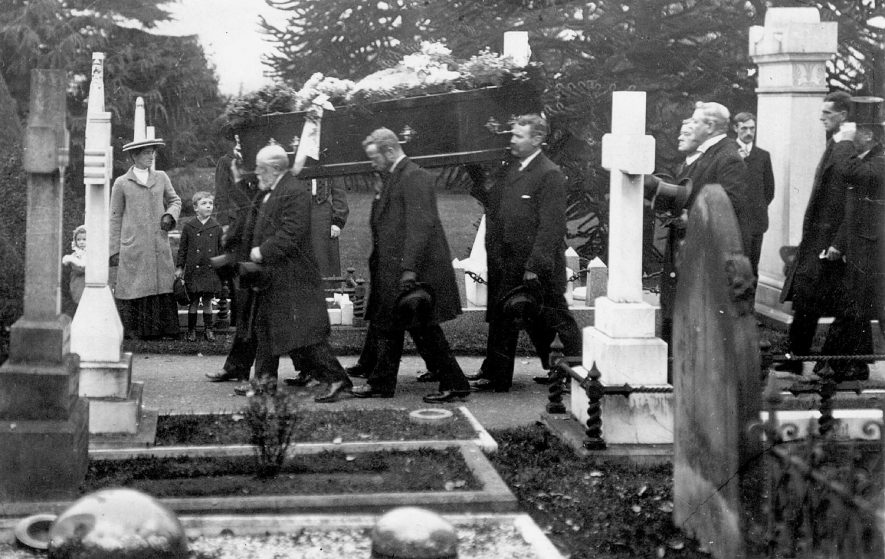
Arrival of a funeral at Leamington Spa Cemetery in Whitnash Road. 1910s. Pallbearers often sustained injuries and worse at funerals due to the heavy weight of the coffin. Wellcome Institute.
Sometimes newspapers gave more gruesome details than were strictly necessary. In 1887 in Kimbolton, an 88 year old pauper, William Ayres, was buried in a coffin that had been incorrectly measured, ‘Nevertheless, the corpse was crammed in, and the head was so turned under the back that only the chin was visible.’ Dr Hallett certified that ‘great violence had been used in forcing the body into the coffin.’ Thankfully, Mr Ayres had his dignity restored when it was ordered that a new coffin be made and the funeral postponed.
Misbehaving Mourners
Mourners at funerals could be troublesome. In 1890 in Dunfermline, Robert Allan, a miner, was arrested for having stolen a satin hat and white tie that he had borrowed for the occasion of his wife’s funeral (a day upon which he was found drunk and disorderly). The sheriff declared him ‘revolting’ and sentenced him to fourteen days imprisonment.
With the heightened emotions experienced at funerals, relatives could become disproportionately upset about small deviations from tradition. In St Lawrence’s Churchyard, Foleshill, Coventry in 1894, a mourner was so offended that the sexton had not thrown earth upon the coffin when the minister had made the committal, that he hit him in the face.
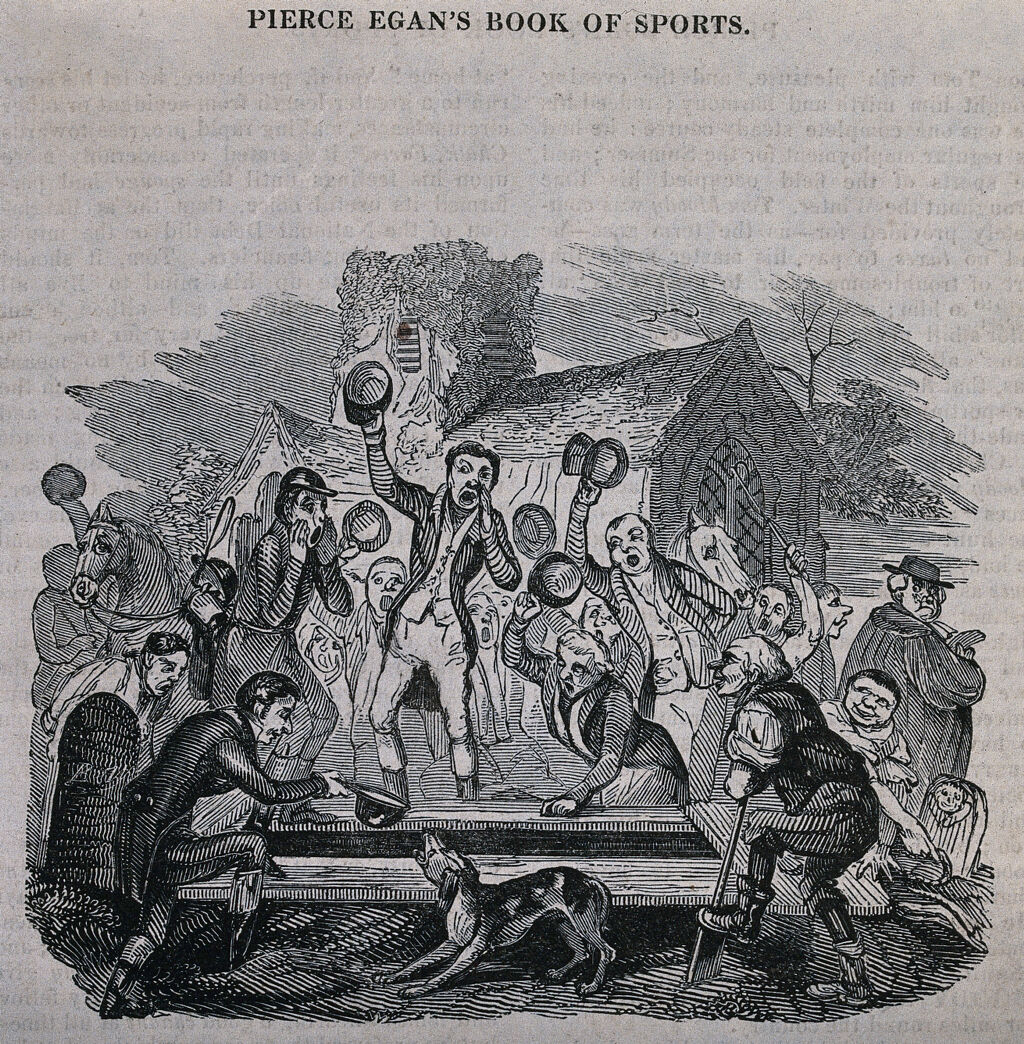
The rowdy funeral of huntsman Tom Moody in 1831. Members of the hunt cried ‘View halloo’ and ‘Tally ho’ over his grave. Wood engraving after R Seymour, 1831. Via Wellcome Institute.
Sometimes, complete carnage broke out over the open grave. A brawl broke out in a Manchester cemetery in 1871 between an elderly woman and her daughter-in-law. The latter had noticed that the mourners had been instructed to wear white hatbands as they would do if the deceased was a bachelor; she thus felt that her (common law) ‘marriage’ to the son had not been acknowledged. Matters deteriorated at the graveside when the ‘mother-in-law’ claimed that the younger one had ‘killed [her] son,’ with other family members joining in and shouting that the younger woman still had a first husband alive in America!
Funerals could also be the locus for tension between different groups in society, especially if the deceased had affiliations to more than one local group. In Plymouth in 1894, a priest turned away Freemasons at the graveside of Dr Aubrey Thomas (a recent convert to the Catholic Church) on the grounds that they were a secret society and, therefore, not recognised by his faith. The Masons stood a little aside, watched the interment from a distance and returned later to throw their traditional sprigs of acacia upon the coffin – the deceased had after all been a Fellow of the Order.
Procedural Problems
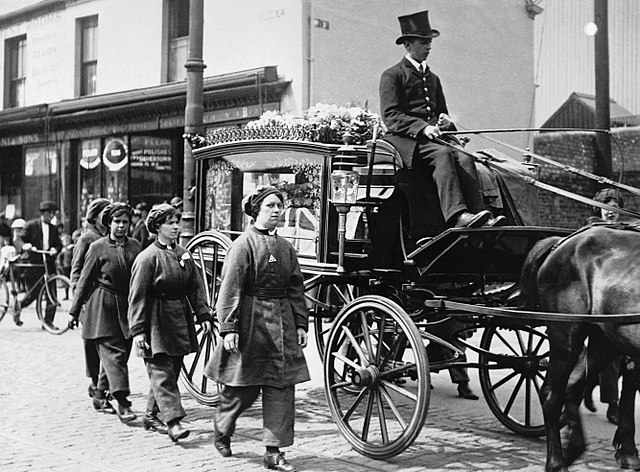
Hearses were still being regularly drawn by horses in the First World War, as here at a funeral attended by female munitions workers for one of their colleagues who had been killed at work in Swansea, 1917. Via Wikimedia Commons
Less excitingly, funerals could also be held up or spoilt for numerous procedural reasons. At a Catholic funeral in Newcastle-under-Lyne in 1882 a priest refused to conduct the ceremony for an aged blind woman because he hadn’t been given the requisite amount of notice. A Congregational Minister, who was conducting a service at a neighbouring graveside at the same time, offered his services, but the family declined because he was not of their faith. Due to the fact that the woman had been deceased for some time, it was considered inexpedient to delay the proceedings any longer and Mrs Macdonald ended up being buried without any ceremony whatsoever.
When people didn’t pay the correct fees for a funeral, services could also be curtailed. At Bethesda near Bangor in 1875, a Welsh family wished to pay in ‘offerings’ rather than by giving the sovereign required for the coffin to be carried on the parish bier. A dispute with the local clergy ensued and the coffin therefore arrived at the cemetery in a lowly ‘trap’ before being carried to the grave on men’s shoulders. The funeral went ahead without any service being read. No doubt this was all a very great embarrassment to the family of the deceased.
As with weddings and baptisms, dramatic accounts of funerals in newspapers provide rare moments when ordinary people from the past act and speak in print. As these examples show, even when they do not directly concern our own ancestors, such accounts are really valuable in helping us build up a picture of how communities and individuals managed the saddest of life’s vital events.
Family History Research Services.
Websites Useful For UK Family History
Magazines
Discover Your Ancestors (online periodical): https://discoveryourancestors.co.uk/
Who Do You Think You Are? Magazine: https://www.family-tree.co.uk/
Family Tree Magazine UK : https://www.family-tree.co.uk/
Commercial Genealogy Sites
Find My Past: https://www.findmypast.co.uk/
The Genealogist: https://www.thegenealogist.co.uk/
Ancestry UK: https://www.thegenealogist.co.uk/
Newspapers British Newspaper Archive: https://www.britishnewspaperarchive.com/
Discover more from searchmyancestry - Ruth A. Symes
Subscribe to get the latest posts sent to your email.


Leave a Reply