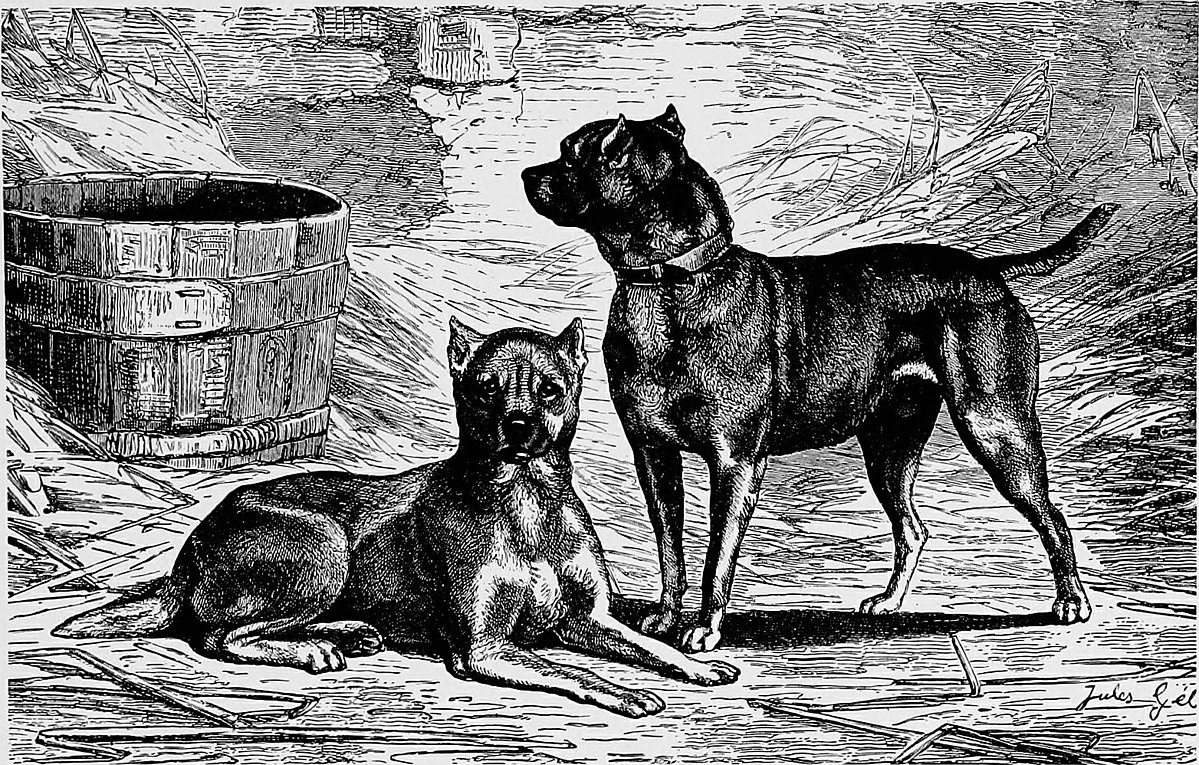
Robert Leighton, The New Book Of The Dog; A Comprehensive Natural History of British Dogs and Their Foreign Relatives, with Chapters on Law, Breeding, Kennel Management, and Veterinary Treatment, Cassell, 1907. Via Wikimedia Commons
It’s pretty difficult to find out much about the pets that our ancestors might have owned in the past, but surprisingly enough, some do turn up on the censuses that can now be searched at www.ancestry.co.uk; www.findmypast.co.uk; www.thegenealogist.com and other big internet family history sites.
From 1841 onwards, ten-yearly censuses were taken of the populations of England, Scotland, Ireland and Wales. The information from the censuses of 1841-1911 is now available to view online. Censuses are detailed records of the people living (or more correctly staying) in homes across Britain on a certain night (usually in March or April). They recorded names of family members, their ages, the relationship of each person to the head of the household, their occupations and certain kinds of infirmity. The census of 1911 additionally recorded how many years a couple had been married, how many children they had had had and how many had survived. There was no obvious column in which to record the name of family pets but some people did so anyway. It was then up to the census enumerator (the fellow who collected the censuses and collated the information) to work out whether any non-human inhabitants had slipped into the record by mistake.Like a Mem
An entertaining example of a dog finding her way onto the census occurred in 1911, when the famous music hall artist, The Great Lafayette (living in the registration district of St Giles and Bloomsbury, London), entered his details on the census stating that he had a 16 year old ‘daughter’ named ‘Beauty.’ Beauty was in fact Lafayette’s dog – a much adored gift to him from the escapologist Harry Houdini. According to the census, Lafayette was living in two rooms in 1911, but other accounts of his life tell us that, in one of his earlier residences, Beauty had her own suite of rooms. She also ate five-course meals and owned a diamond studded-collar!
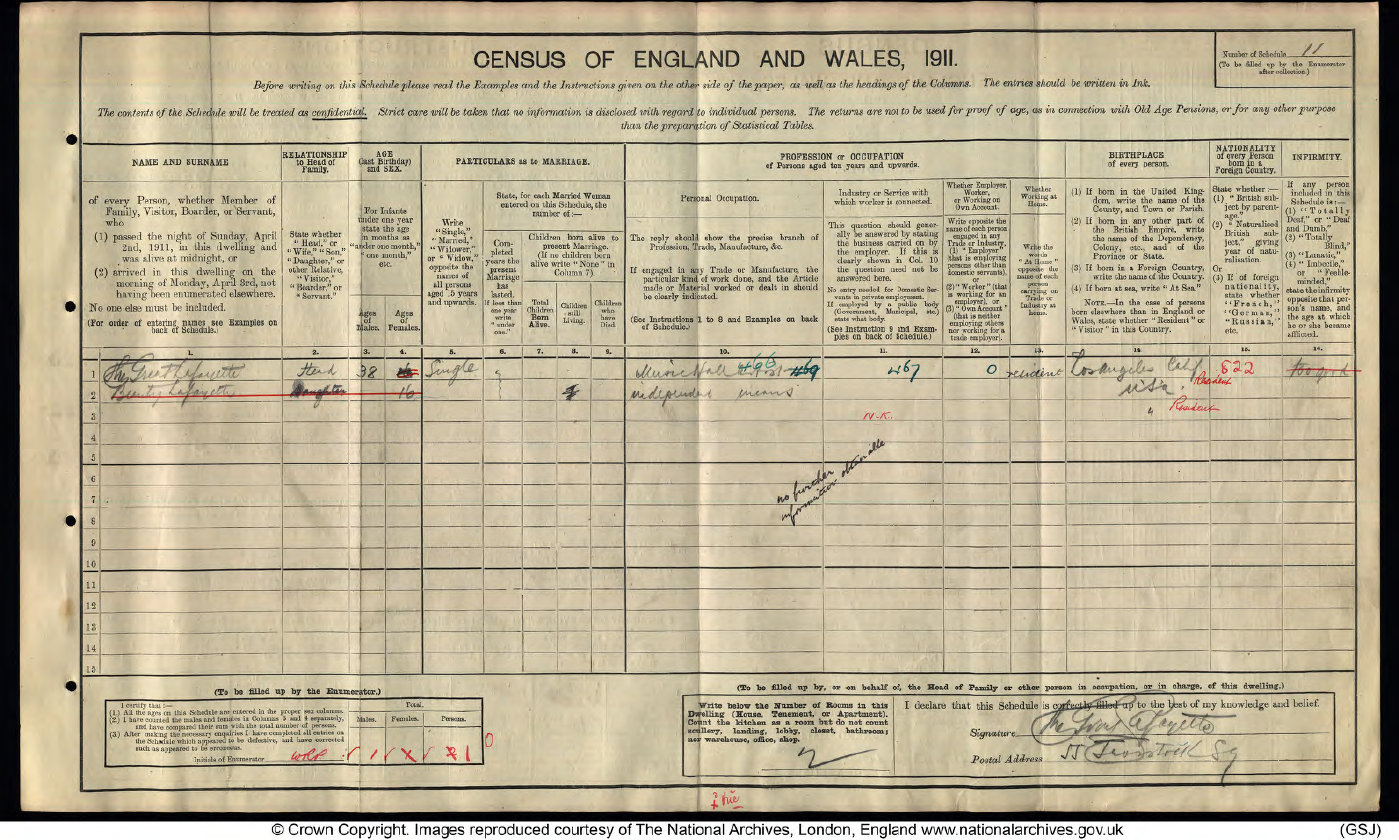
The Great Lafayette registering himself and his dog Beauty on the 1911 census, http://www.findmypast.co.uk
Lafayette was a master illusionist, rejoicing in the absurd, and he would have enjoyed playing this joke about his dog on the census enumerator, but Beauty was by no means the only family pet to enter the census records in this way. That same year, for instance, a more ordinary family, the Cullens, living in Dublin recorded, in addition to their six children, an unidentified family member named ‘Tatters’ aged 3!
Dogs must have been the bane of the census enumerators’ lives. In dropping off and picking up the schedule at individual addresses, the enumerator would have had to face being chased or bitten by dogs guarding properties. Where the enumerator himself spent any length of time in the house helping the family to fill in the census, he would have had to contend with the noise of barking dogs and potential canine hostility, since he might have been perceived as an unwelcome stranger. The dogs that surreptitiously found their way on to the censuses were yet one more problem. In both the case of the Great Lafayette and of the Cullen family, the suspicions of the census enumerator were aroused and a red line was later scored through the entries. Beauty and Tatters failed to get into national statistics.
Some people genuinely did not know whether or not to include their dog on the census. James Little, a journalist with a young family, who had evidently moved up from London to work in York, scribbled at the bottom of his census form in 1911, ‘Incidentally, we have an Airedale Terrier named Roger. I do not know whether particulars are required, but in case you want them here they are.’ He then proceeded to give Roger’s age, ‘5’, his occupation, ‘watch dog’, his industry, ‘looking after house,’ and his place of birth, Keighley.’ In answer to those all-important extra questions in that particular census about fertility, Mr Smith recorded that he had lost count of the number of progeny that Roger had fathered but that it was over 100!
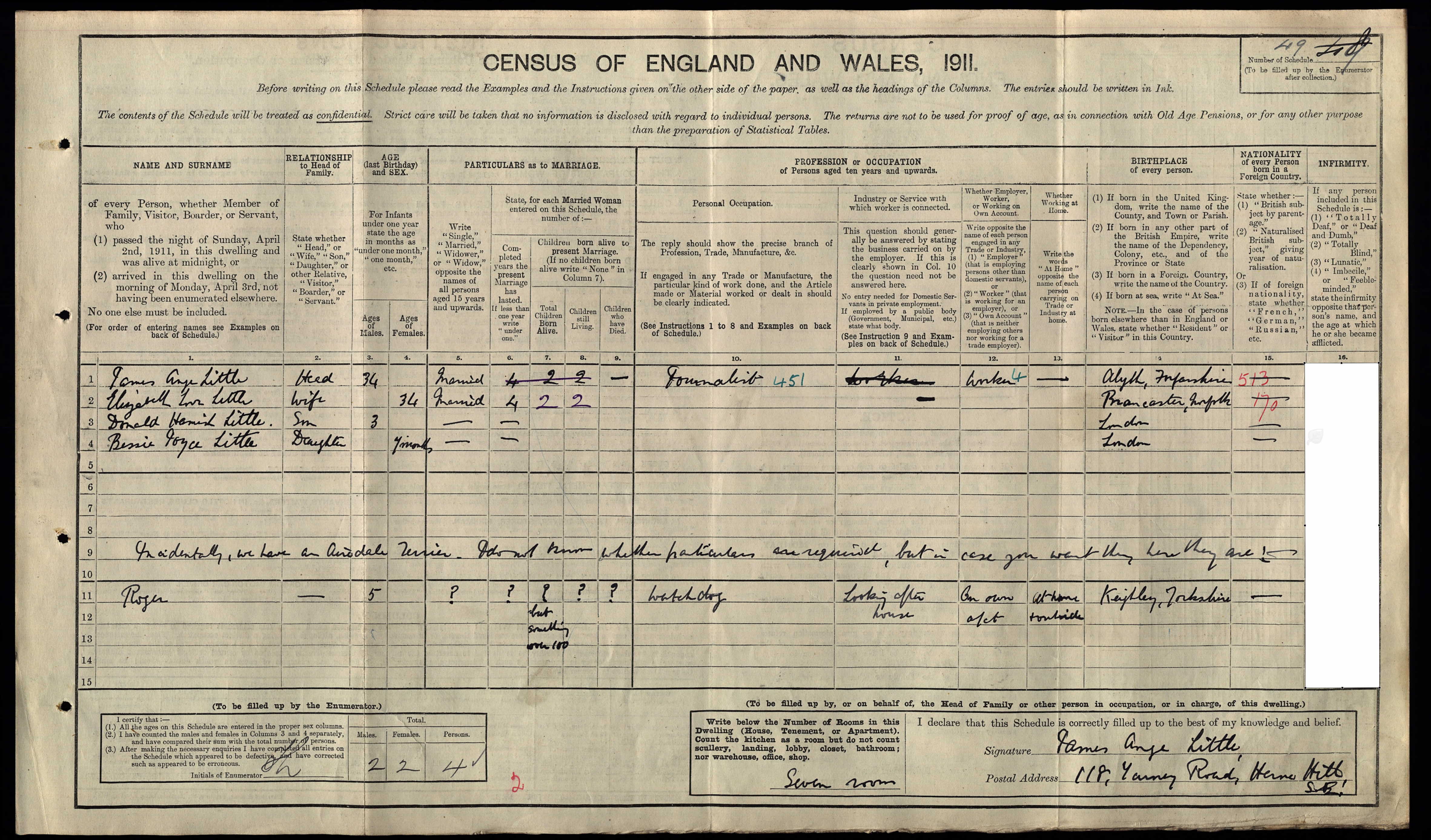
Entry for the Little family in the 1911 census including details about their dog Roger. http://www.findmypast.co.uk
Early censuses, between 1801-1831, were just a head count of the population and not properly standardised. . Enumerators for these early censuses were not asked to compile personal information on individuals and could pretty much record what they liked. The 1821 census for Hendon, London, for example, includes a count of the number of windows and the number of dogs present in each household. It is, therefore, possible, if you know an ancestor’s address and are searching these early censuses, that you will not be able to find out the names of any of the children in the household, but you will be able to find out how many dogs it had! The early censuses are not available on the usual family history websites but some of the returns can be viewed in local archives (the Hendon one is at Barnet Archives, London).
If your ancestors weren’t silly or witty enough to include the names of their dogs in the census, you might be able to infer that they kept them from the titles of their occupations: dog catchers’, ‘dog killers’ (employed by the parish to do away with stray dogs), ‘dog groomers’, ‘dog wardens’, ‘dog muzzle makers’, and ‘dog breakers’ (trainers), are frequently recorded; or by their addresses, names of farms, veterinary surgeries or ‘The Kennels,’ for example.
It seems that from the late-Victorian period, dogs were starting to occupy that favoured position in British society for which they have internationally become so well-known. No longer only kept in outbuildings or kennels as rat-catchers, guard dogs or hunting dogs, it looks as though late Victorian and early twentieth-century canines were well and truly considered part of the family.
[This article was first published in Family Tree Magazine UK, 2012]
See also my article on dogs in family photos
Family History Research Services
Link to buy my books Amazon.co.uk: Ruth A Symes: books, biography, latest update
| Websites Useful For UK Family History Magazines Discover Your Ancestors (online periodical): https://discoveryourancestors.co.uk/ Who Do You Think You Are? Magazine: https://www.family-tree.co.uk/ Family Tree Magazine UK : https://www.family-tree.co.uk/ Commercial Genealogy Sites Find My Past: https://www.findmypast.co.uk/ The Genealogist: https://www.thegenealogist.co.uk/ Ancestry UK: https://www.thegenealogist.co.uk/ Newspapers British Newspaper Archive: https://www.britishnewspaperarchive.com/ |
Discover more from searchmyancestry - Ruth A. Symes
Subscribe to get the latest posts sent to your email.


I love this!!!
LikeLike