by Ruth A. Symes
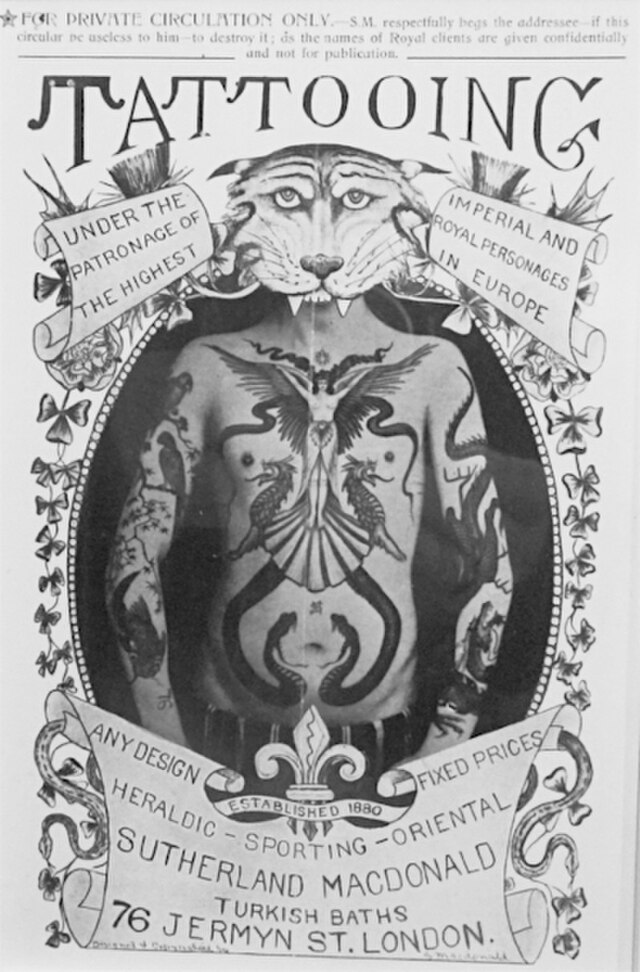
Advert for Sutherland Macdonald tattooing studio, London, 1905. Via Wikimedia Commons. In the public domain. [[File:Poster for Sutherland Macdonald tattoo studio (ca.1905).jpg|Poster_for_Sutherland_Macdonald_tattoo_studio_(ca._1905)]]
[A version of this article was first published in Who Do You think You Are ? Magazine, 2012]
The desire to self-decorate is not a modern phenomenon, nor is it the provenance of twenty-first century celebrity or eccentricity. Our ancestors of the past couple of hundred years (from many different walks of life) may have sported tattoos. A friend was recently researching an ancestor who was a conductor on the Manchester trams in the early years of the twentieth century. She knew little about him apart from the fact that he had died in his forties; no living member of her family recalled him and she had no photographs. Thus, she was thrilled to discover from his military records (accessed through www.findmypast.co.uk) that he had sported a tattoo of a ballerina on his right forearm! Suddenly, this mysterious relative came to life. What sort of man would champion such an image? Was the ballerina a girlfriend, a wife, or just a bit of fantasy? Was the tattoo a carefully considered tribute to a relationship, or a terrible mistake acquired during a moment of madness?
You may discover that your ancestor had tattoos from photographs, passports, prison records or even just hearsay. And these intricate, colourful and enigmatic emblems may certainly repay further investigation. Celebrities such as David Beckham and Angelina Jolie are certainly not the first people in history to have had the names of their children tattooed onto their arms – surely the most intimate of all family trees! Indeed, if the message boards of genealogical websites are anything to go by, tattoos are a source of much fascination and speculation amongst family historians across the world. Such sites are awash with people searching for information about ancestors and missing relatives who might be identified by their distinctive body decoration.
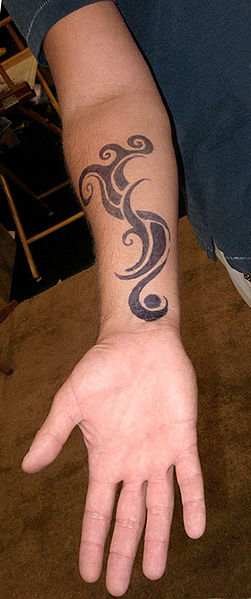
Decoration, object of fetish, or punishment? Tattoos have often had multiple significances.From Wikimedia Commons. Pascal Giacomini, 2009.
Tattoos: a Brief History
Tattooing has an ancient heritage in many cultures, including North European ones. After disappearing from our shores for many centuries, however, the art was rediscovered and reintroduced after explorers visited distant parts of the world in the sixteenth, seventeenth and eighteenth centuries.
European sailors started to acquire tattoos after Captain James Cook sailed the South Pacific and arrived on the island of Tahiti in 1768. Intrigued by the local practice of body painting (the word ‘tattoo’ is probably derived from the Tahitian word ‘tatau’) many of the sailors, including Cook’s Science Officer and Expedition Botanist, Sir James Banks, obtained their own tattoos. Once back in Britain, the sailors showed off their distinctive inkings, and a new craze was born.
In the early days, tattooing in Britain was done by hand using a needle. Ink was then rubbed into the wound. Tattoos were popular amongst working men (and women) from the late eighteenth century onwards but the practice was at first confined to a few parlours in seaside ports. In the last decades of the nineteenth century, however, tattooing became surprisingly upmarket, appealing even to members of the British Royal family and the aristocracy. In 1891, an electric tattooing machine (based on Edison’s electric pen) was patented by American Samuel O’Reilly and soon adopted on this side of the Atlantic. The electric machine meant that body decoration could now be obtained at a reasonable price. As tattoos came once more within the budget of more of our ordinary ancestors, tattoos started to lose their appeal for the upper classes.
The size, shape, colouring and positioning of tattoos was, of course, largely a matter of individual choice but, as the craft developed, some designs became standard and could be customised according to the client’s needs. If you become aware (from written descriptions) that your ancestor had tattoos, you may be able to find the actual design and its possible significance in one of the many books of vintage tattoos (see reading list below). Working out why your ancestor chose to have a tattoo, of course, will be a matter of guesswork because tattoos have always had many possible meanings. The earliest may even have been used for medicinal purposes – to cure arthritis in the joints, for example. Later tattoos were used to convey ideas of status, belonging, patriotism, achievement or conquest. Sometimes they recognised a relationship or an important date. Occasionally, they paid tribute to a type of employment, interest or hobby. Additionally, they might have provided sexual titillation, or registered a protest against someone or something.
Sailors and Tattoos
Nautical men are the most likely of our ancestors to have had tattoos. Some sailors opted for simple designs, popularly their own name or initials, or the names of family and friends; others flaunted the names of places visited around the world. Some common tattoos adopted by many sailors promised to guarantee good fortune in what was a very hazardous career. Two stars, for example, suggested that the bearer might always find his way to his desired destination. A rooster and a pig decorating the calves or feet were thought to ensure safety at sea probably because these animals (travelling as they did in lightweight wooden crates) often survived shipwrecks. Other tattoos may tell us more about our sailor ancestor’s individual career at sea: sailing 5000 nautical miles (a swallow); sailing the Atlantic (an anchor); crossing the equator (a turtle standing on its back legs, or King Neptune); sailing around Cape Horn (a full-rigged ship often across the whole back); sailing into the port of China (a dragon); crossing the international dateline (a Golden dragon).
Other nautical tattoos were more intricate and may have signified a prevailing maxim by which a life was lived. A man carrying an anchor, for instance, stood for ‘I carry all my hopes with me;’ and a woman holding scales and an anchor for ‘I have hope in justice.’ Some tattoos signalled a specific job role. A dock worker, for example, might be decorated with a rope around the forearm; a member of the Fishing Fleet might sport a harpoon; guns or crossed cannon indicated military naval service.
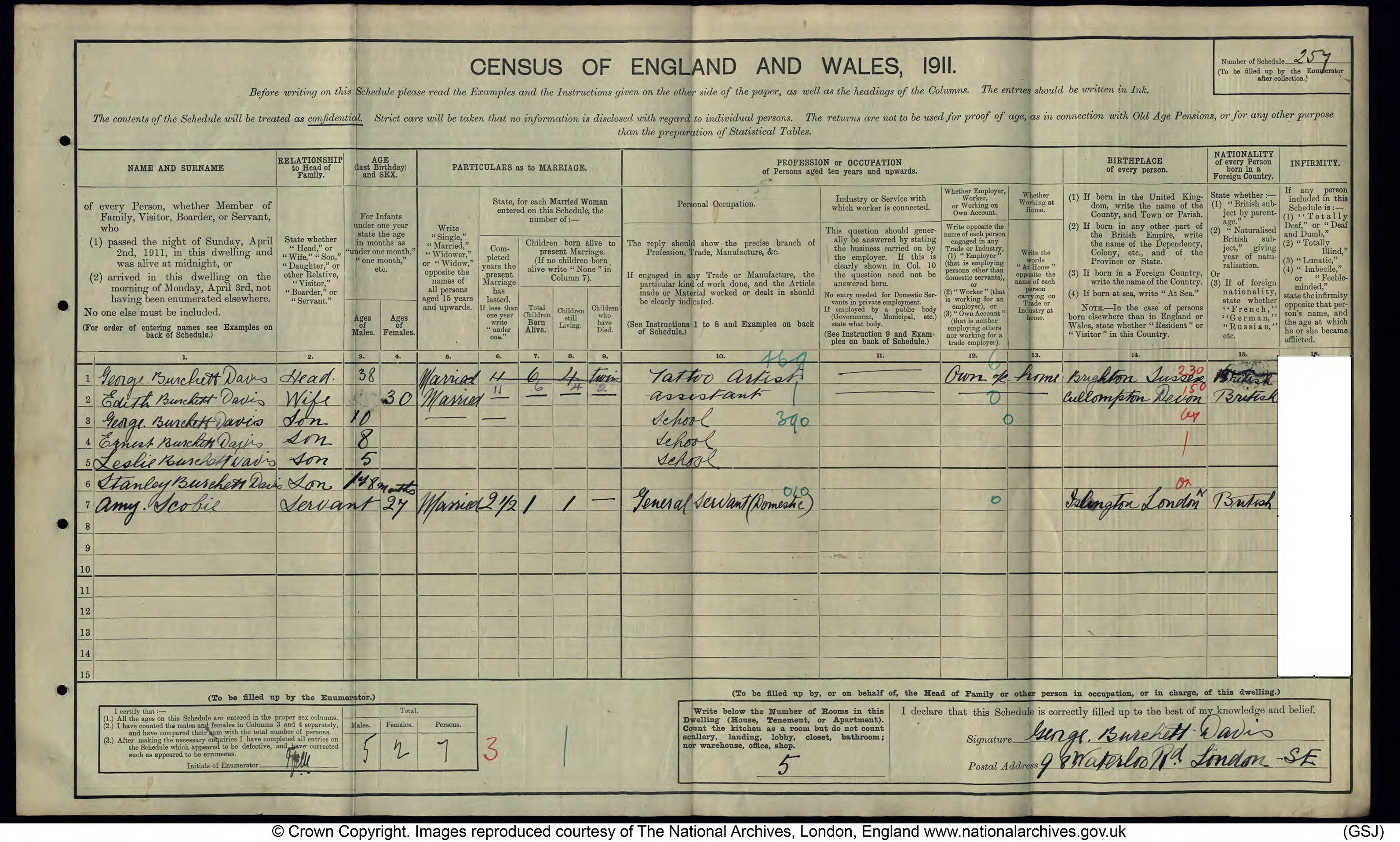
The 1911 Census entry for the well-known tattoo artist George Burdett Davis who worked from home at 98 Waterloo Road, London. From www.thegenealogist.co.uk
Convicts, Transportation and Tattoos
Richly described in ships’ records, nineteenth-century convict ancestors who were transported to the penal colonies of Australia often sported tattoos. Common designs included suns, stars, mermaids, fish, flowerpots and bugles. Ex-labourer Edward Byrne, for example, was a convict on the Phoebe Dunbar which travelled from Kingstown in Ireland to Swan River Colony, Western Australia in 1853. According to the ship’s records (available to view at http://www.convictcentral.com/), he bore a tattoo of the letter ‘E’ on his left arm, and ‘EP’ (possibly a mistake in transcription for his initials ‘EB’) on his right arm. Another convict aboard the same ship, James Casey, bore an ink ring on the second finger of both his right and left hands and an anchor on his back. And fellow convict Michael Doyle was more gloriously decorated still with the word ‘SWEEP’ and 2 anchors on his right arm, ‘a laurel, a tree and a star on his right band [sic]’, ‘an anchor on his left arm’ and ‘a cross on the back of his left hand’.
The tattoos of such convicts may have been more than mere decoration. The age-old practice of branding criminals in Britain with a hot or cold iron had been made obsolete in 1829 but, in the mid nineteenth century, badly-behaved soldiers were still being tattooed (using ink or gunpowder) with a D’ for ‘Deserter’ or ‘BC’ for ‘Bad Character.’ From 1851, the tattooing of soldiers had to be carried by a regimental surgeon rather than a Drum-Major or Bugle-Major as had originally been the case. The British Mutiny Act of 1858 stipulated that deserters be marked on the left side 2 inches below the armpit with a letter ‘D’, not less than an inch long. Tattooing as punishment was outlawed in Britain in 1879. Other convict tattoos may have been badges of honour; some criminal gangs in London insisted on tattooing as a mark of belonging. And the rings inked on the fingers of some convicts may have been an indication of real or ‘de facto’ marriages.
Tattoos and the Aristocracy
From the mid-nineteenth century onwards, tattoos came to be considered exotic and even lavish fashion items. The fad was even endorsed by royalty; in 1862, the Prince of Wales, later Edward VII, visited the Holy Land and had a small tattoo of the Jerusalem Cross tattooed on his arm. Twenty years later, his two sons, the Duke of Clarence and the Duke of York (later George V) travelled to Japan and acquired dragon tattoos (etched by the master tattooist Hori Chiro).
The passion for tattoos amongst the British aristocracy caused consternation amongst the Japanese authorities who thought the practice old-fashioned and barbaric. Nevertheless, artistic tattoos acquired in Japan (known as ‘irezumi’) were very popular in British high society in the 1890s. By 1898, there were also about twenty tattoo artists at work in London including three masters of the art: Tom Reilly (The Strand), Sutherland McDonald (Jermyn Street), and brothers George Burchett (Davis) and Charles Davis (Waterloo Road). Favourite designs for aristocrats were family crests, birds, serpents, flowers and plants. Army officers demanded regimental logos, and sportsmen wanted inspirational images such as running horses. Thomas Lipton (1848-1931), the famous British tea merchant reputedly had a tattoo of a sailing ship across his chest.
By 1895, some members of Parliament were sporting tattoos of initials, family crests and shields. Lord Charles Beresford (1846-1919), a British Admiral and Member of Parliament is rumoured to have had a large tattoo of a fox hunting scene tattooed on his back (or, in some accounts, on his buttocks!). And the craze for tattoos amongst the rich and powerful continued long into the twentieth century with even the Norwegian king, Haakon VII, getting a tattoo during his exile in London during the Second World War.
Aristocratic women also sometimes sported tattoos. Lady Randolph Churchill (mother of Prime Minister Winston Churchill) (1854-1921) is said to have had an etching of a serpent in red, green and blue on her wrist which she would cover up with a specially-made silver bracelet when propriety so decreed, whilst the eccentric Princess Marie of Denmark (1865-1909) had a tattoo of an anchor inked on her arm.
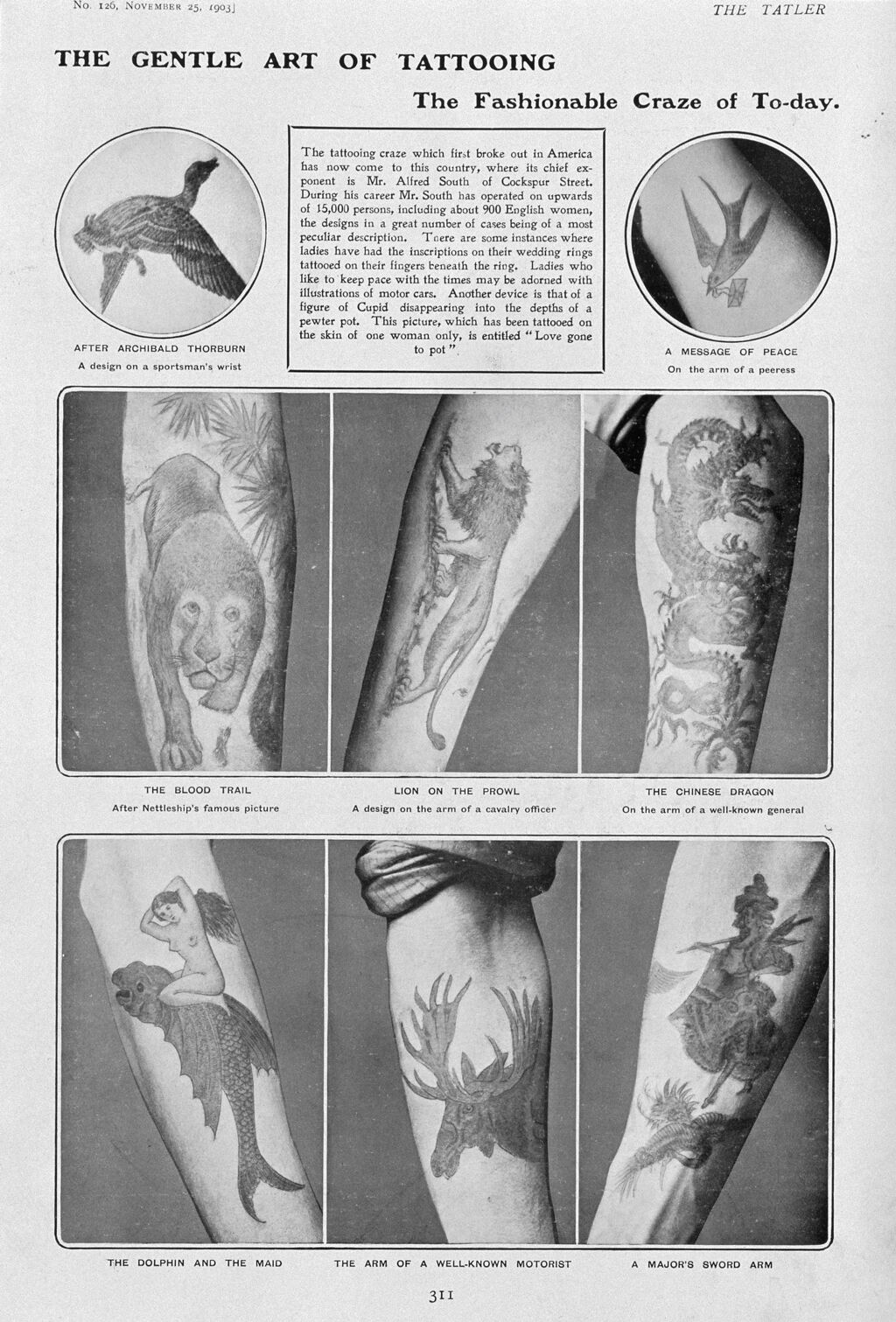
From The Tatler, London, 25th November 1903. The text comments on the new craze for tattooing which has recently reached Britain from America, Wellcome Institute.
Tattoos and the Circus
Every major circus in the nineteenth and early twentieth centuries employed several heavily tattooed people: some as sideshow attractions and others as circus performers such as jugglers and sword swallowers. In America, the tattooed lady was a regular sight in the circus. In addition to their visual peculiarities, these highly-painted characters provided entertainment by telling gripping tales of having been captured by savages and tattooed against their will. Some of our ancestors may have obtained their tattoos from artists who practised and exhibited at travelling circuses during the spring and summer before returning to their urban studios in the winter.
Tattooing in the Concentration Camps
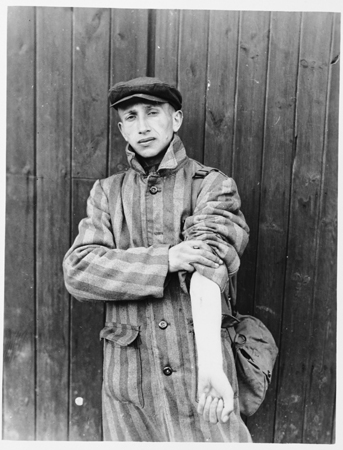
A survivor of Buchenwald Concentration Camp, Germany, shows his identification tattoo, 1944. Obtained via Wikimedia Commons from the United States Holocaust Memorial Museum, courtesy of Stanley Moroknek.
Unfortunately, some of our ancestors’ tattoos have a far more sinister heritage. Prisoners including Jews, Gypsies and other ‘undesirables’ arriving at the Auschwitz Concentration Camp complex during the Second World War were branded with serial numbers by the SS authorities from the autumn of 1941 onwards. Initially the numbers were made across the upper left chest using a special metal stamp with interchangeable numbers comprising 1cm long needles. The number was punched at one blow and indelible ink was then rubbed into the wound. Later a single needle was used and the number was tattooed onto the outer side of the left forearm (some prisoners had numbers tattooed on the inner side of the left forearm). Those people sent directly to the gas chambers were not registered or given serial numbers.
Useful Books
James Bradley et al, Written on the Body: The Tattoo in European and American History, Reaktion Books, 2000.
Carol Clerk, Vintage Tattoos, Carlton Books, 2011.
Steven G. Gilbert, Tattoo History: A Sourcebook, Juno Books, 2000.
David T. Hawkings, Criminal Ancestors, Stroud, 1996.
Margot Mifflin, Bodies of Subversion: A Secret History of Women and Tattoo, Juno Publishing, 2001.
Useful Websites
www.tattoomuseum.co.uk Liverpool Tattoo Museum.
http://19thcentury.wordpress.com/2007/11/11/19th-century-tattoos/ On the history of nineteenth-century tattoos.
http://www.ushmm.org/wlc/en/article.php?ModuleId=10007056 Tattoos and numbers: the practice of identifying prisoners at Auschwitz.
http://www.tattooarchive.com/tattoo_history/burchett_george_charles.html On the tattoo artists George Burchett and Charles Davis.
http://www.convictcentral.com/. Records of transportation of convicts to Australia.
British Tattoo History Museum, 389, Cowley Road, Oxford, OX4 2BS
Discover more from searchmyancestry - Ruth A. Symes
Subscribe to get the latest posts sent to your email.


Leave a Reply