By Ruth A Symes
This article first appeared in the online periodical Discover Your Ancestors (March, 2026) http://www.discoveryourancestors.co.uk
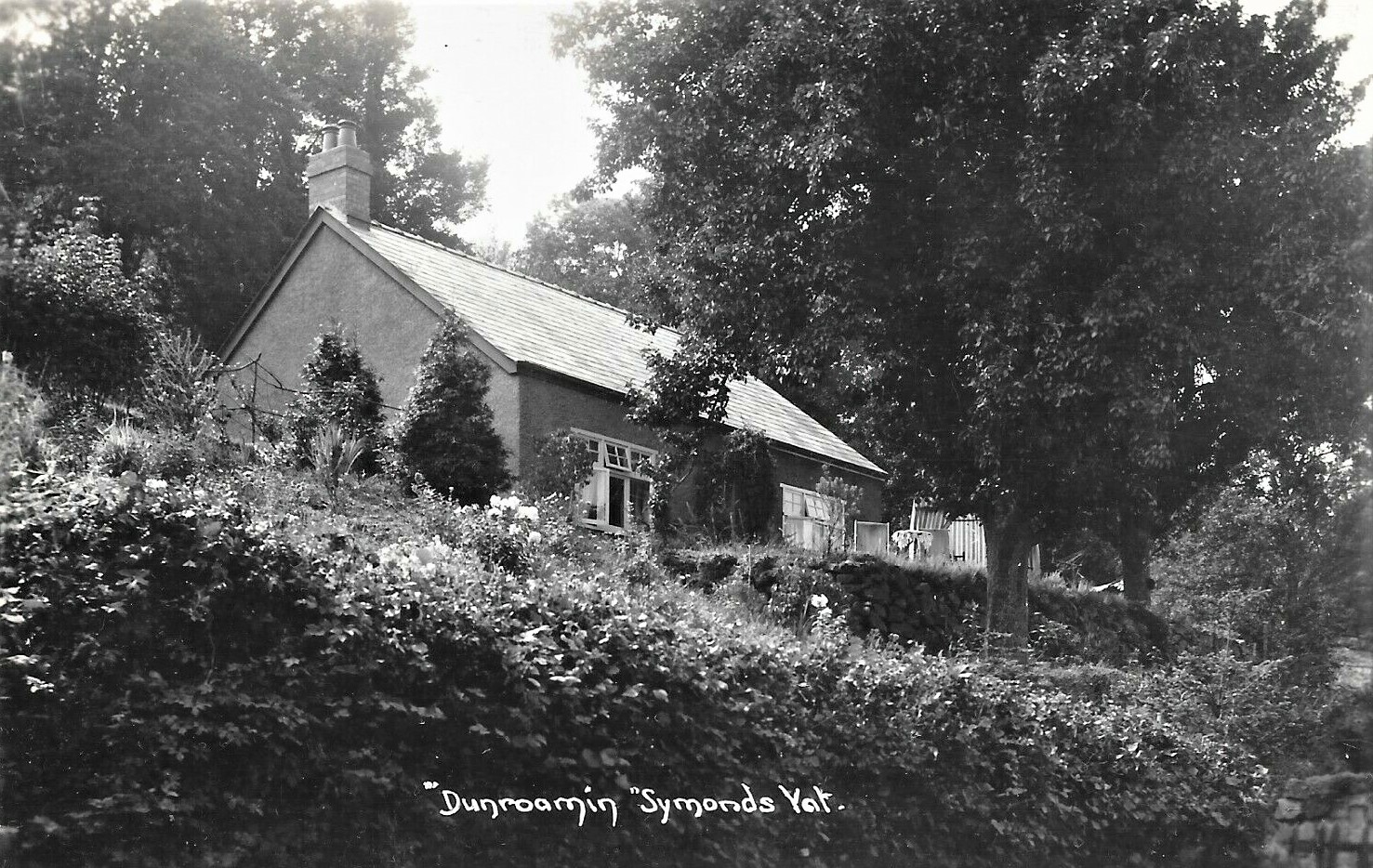
A cottage with perhaps the most well-known of all British house names often given by those who had come to rest after a life of work and travel, ‘Dunroamin,’ Symonds Yat, Herefordshire. Via Wikimedia Commons.
In Britain, house names are much older than house numbers; some homes indeed still carry the names they were given when first built in medieval times. Despite the fact that in 1765 the Postage Act made it mandatory for all new properties to have a house number and a street name (and later, the Metropolis Management Act of 1855 made these requirements more stringent), the desire to name houses continued. As Victorian cities expanded into suburban areas, building often occurred in a piecemeal fashion. On incomplete roads, houses could only be numbered once all the houses had been built, something which meant that many residences identified themselves only by name at first.
Victorian and Edwardian houses with names were often substantial villas with appellations that remind us of the class and education of their owners. But the period between the two World Wars saw enormous numbers of new houses built in the form of both middle-class suburbs and council estates. At this point, house-naming became something of a popular fad indulged in by people from all walks of life. Visitors to the country were fascinated by what they took to be a delightful example of British eccentricity. In March 1921, a British newspaper (Shields Daily News) quoted the American essayist and naturalist John Burroughs, “I liked the English habit of naming their houses: it shows the importance they attach to their homes. All about the suburbs of London and in the outlying villages, I noticed nearly every house and cottage had some appropriate designation as ‘Terrace House,’ ‘Oaktree House,’ ‘Ivy Cottage,’ or ‘Some Villa’ etc, usually cut into the stone gatepost and this name is put on the address of the letters. How much better to be known by your name than by your number! I believe the same custom prevails in the country. It is a good feature. A house or farm with an appropriate name which everyone recognises, must have an added value and importance.”
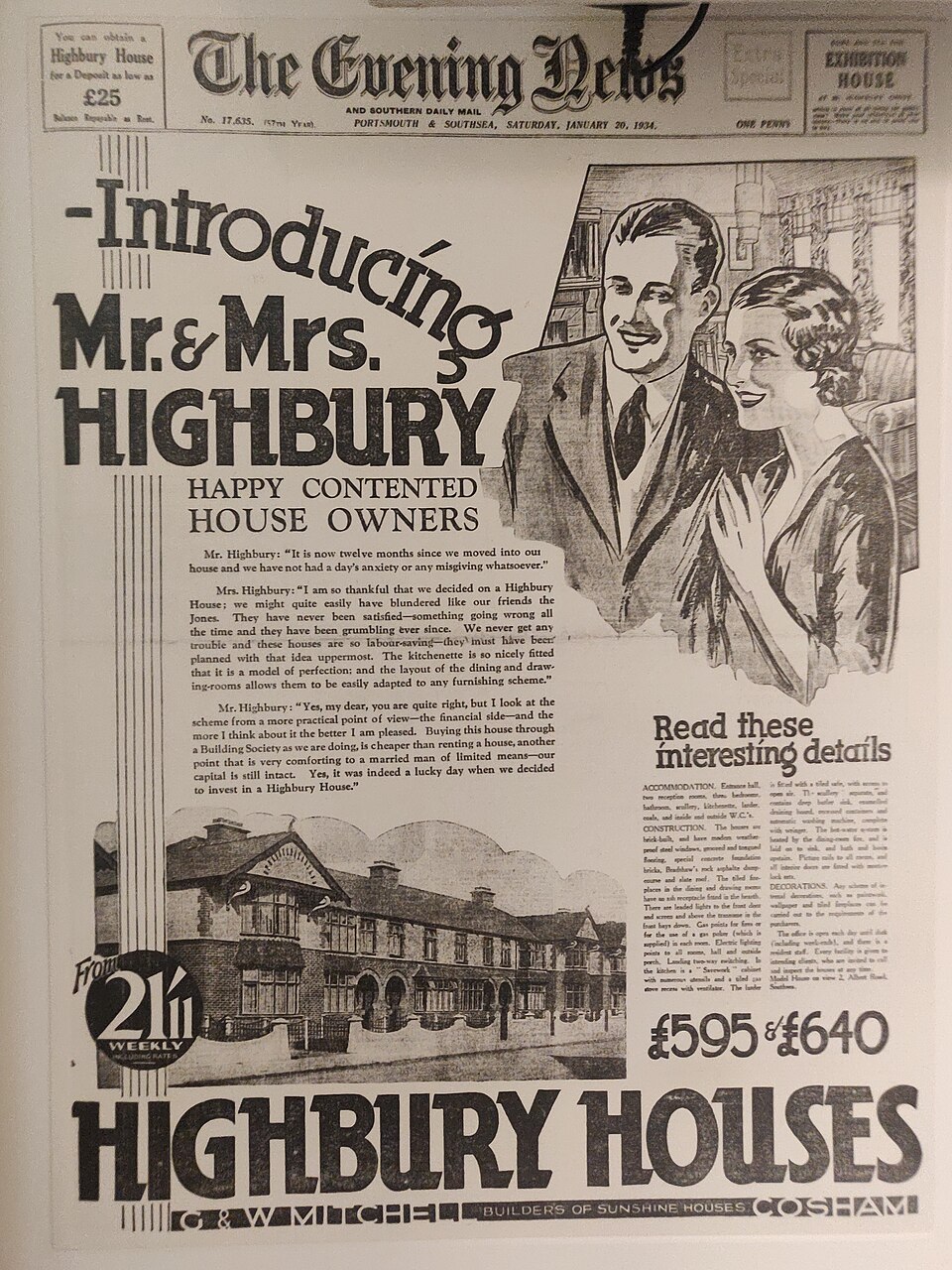
House buying came within the grasp of more and more couples in the settled period between the World Wars. Advert for Highbury Houses which could be bought with a deposit of as little as £25, The Evening News and Southern Daily Mail (Portsmouth and Southsea) Saturday, January 20th, 1934. Neighbourhood just South of Cosham. Via Wikimedia Commons.
House Names and Your Family
You may turn up the name of a home that belonged to your family in census material, title deeds, electoral rolls, or even as a passing reference in a newspaper, letter or telegram. Whilst house names officially needed to be registered after the Land Registration Act of 1925, this requirement was not strictly enforced straightaway.
For some, owning a house was a family first that begged for public acknowledgement in the form of a nameplate on wall or gate. And, for family history purposes, it might be worth remembering that it was often our female relatives who came up with the moniker for their properties. The Midlothian Advertiser of August 7th, 1931 suggested that “women were the ones most responsible for naming houses. As mothers have most to say in naming the child, so the final decision in finding a name to suit the house finally rests with her. … .”
Some researchers have discovered gems of information in the names of their ancestors’ homes. Newly-married property owners sometimes drew attention to their status with house names which combined the couple’s Christian names, such as ‘Evefred’ or, less helpfully, ‘UandI’ or ‘Ersanmyne.’ Some owners took their surnames (or the surnames of older generations) and placed them before neutral suffixes such as ‘dene’ (in some examples of this, the name was reversed). Other house names were acronyms to commemorate stages reached in life: one small suburban villa in Ramsgate, for example, was named Aral (Ambition Realised At Last). Frequently, house names give us a clue as to when the house was named. A home in Church Hill, Purley, for instance, was named ‘Winston,’ as an apt play on the whole address and as a nod to the Prime Minister of the time.
Whilst much older houses often took their names from the employment of those who resided there, or the original purpose of the building itself (e.g. Blacksmith’s Cottage), the modern houses of the 1920s and 30s were more likely to be named after places in which owners, with a little more leisure time, had holidayed. In 1931, a journalist walking through Finchley, North London commented on how many of the houses were named after beautiful places in Devon and Cornwall and mused on how many houses in the country as a whole might possibly be named ‘Clovelly’ after ‘surely the prettiest holiday town of all in the South West.’
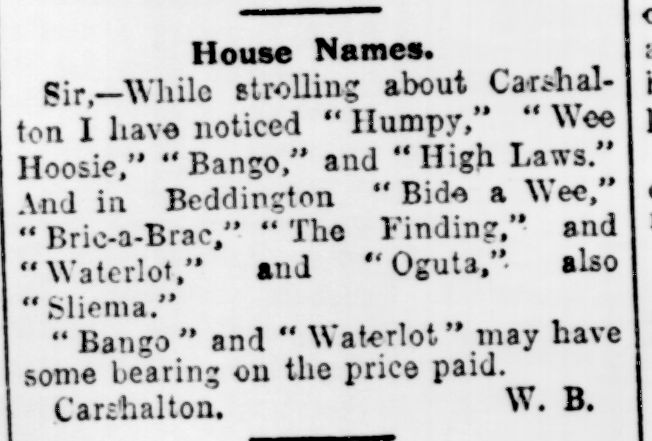
Newspapers sometimes ran competitions or letters pages devoted to the unusual names that had been spotted on gateposts and front doors. London Daily Chronicle, September 22nd, 1927. http://www.findmypast.co.uk
Even if no use to us in terms of genealogy, some house names might tell us something about the states of mind of our ancestors when naming them. Two houses spotted on a road in Leicester in 1927 were named ‘Atlastahouse’ and ‘Whi-Whurry.’ Humour certainly played a big part in house-naming. The Framlingham Weekly News (17th September, 1938) commented on a house named ‘Auft – n – Oot,’ going on to comment, “this unusual house name has broken out as the latest symptom in Birmingham of a craze for unusual names. While it may not be very complimentary to a house that its occupants are ‘often out,’ it is original. In the same district is a house with the name ‘Neverin’ and another called ‘Faraway.’”

A typical Victorian house with a name, Norwood, Chestnut Avenue, Hessle. Part of the Davenport estate built between 1895 and 1905. Via Wikimedia Commons.
Case Study in Boston, Lincolnshire [Boxout]
On December 11th 1937, an inquisitive reporter from the Lincolnshire Standard took it upon himself to walk down a few roads in the town of Boston (where all the houses had names) in order to find out the reasons behind them. A selection of his findings were printed. They included:
“Eringo”
This turned out to be a shortened form of the Latin name Erynguim Maritimum – ‘a genus of rigid often glaucous herbs.’ On further exploration, it became clear that the owner of the house, a Mr Ward, had named it after a herb more commonly known as ‘Sea Holly’ which grew nearby on the coast. As Mr Ward was himself ‘a herbalist’ in West Street, the choice of house name made perfect sense.
“Wychelonde”
The owner of this house, a Mr Westland, claimed that he was descended from a much older (thirteenth-century) local Lincolnshire family named Wychelonde. He had, therefore, reintroduced the seven hundred year-old spelling of his name when naming his house.
“Fenella” (formerly Brycol)
This name had apparently been chosen ‘haphazardly’ by the owner of the house after a favourite character in a novel, though she couldn’t recall the name of the book. The lady had been anxious to replace the previous name of the house ‘Brycol’ which had been a portmanteau term derived from the names Bryan and Colin, the two children of the former owners.
“Vi- Ro-Von-To”
Despite the reporter’s initial guess that this was an aborigine term derived from the owner’s ‘far-flung wanderings in a vast Australia’, an interview revealed this: ‘ “Vi”– for Victor, the husband, father. “Ro” for Rose Charlotte the wife and mother, “Von”, a diminutive for Yvonne, the 10 year old daughter, and “To” for Tony, the 12 year old son.’
“Megan”
This house on Broadfield Lane was named for the middle name of its owner Mrs Appleby. As a child she had called been called Miss Constance Megan Butler and her claim to fame was that she was the first child born in Boston whose mother had received benefit under the Maternity Benefit Section of Lloyd George’s National Insurance Act. She had been born on February 15th, 1913 and was named after Lloyd George’s daughter (Lady Megan Arvon Lloyd George).
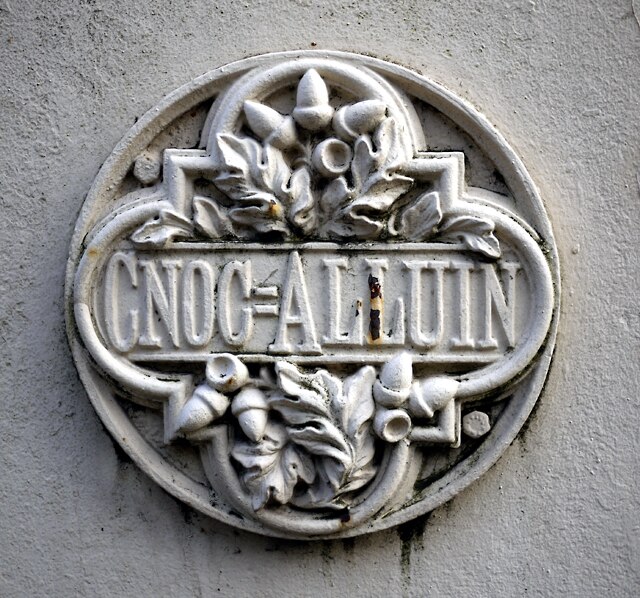
A decorative nameplate for a house on the Malone Road in Belfast. ‘Cnoc Alluin’ is actually the name of a hill in Stirling, Inverness-shire. The house is now occupied by Queen’s University, Belfast. Via Wikimedia Commons.
Calls for an End to House Naming
The prolific house naming of the interwar period was heavily criticised in the press. Some sneered at the sheer snobbishness of the practice, especially when fancy names were being attached to very modest homes. Others mocked the inappropriateness of some names. As one journalist from the North-West commented, “You find a house called ‘Broadacres’ and you find a piece of grass for a lawn just about large enough to put the aspidistras on when it rains…. We have in Morecambe scores of plain little houses with names such as ‘San Remo,’ ‘San Malo,’ ‘Woodland Dell.’ Studying them, I decided that Brittany and Spain must be sadly overrated places.” Morecambe Guardian, 21st March 1930. A journalist in London bemoaned the stupidity of owners who claimed natural-sounding names for houses in built-up areas. ‘In and around Wood Green we have ‘Hill Sides,’ ‘Hill Crests’ and ‘River Views’ with ne’er a real hill or a river in sight.” He went on to disparage other inappropriate names, “The Gables” in the middle of a row, a ‘Buena Vesta’ (meaning a pleasing view) opposite some barren land… and ‘Ty Gwyn’ [which] is Welsh for White House but one finds everything ‘paintable’ either dark brown or green.” Woodgreen and Southgate Weekly, 15th March, 1932.
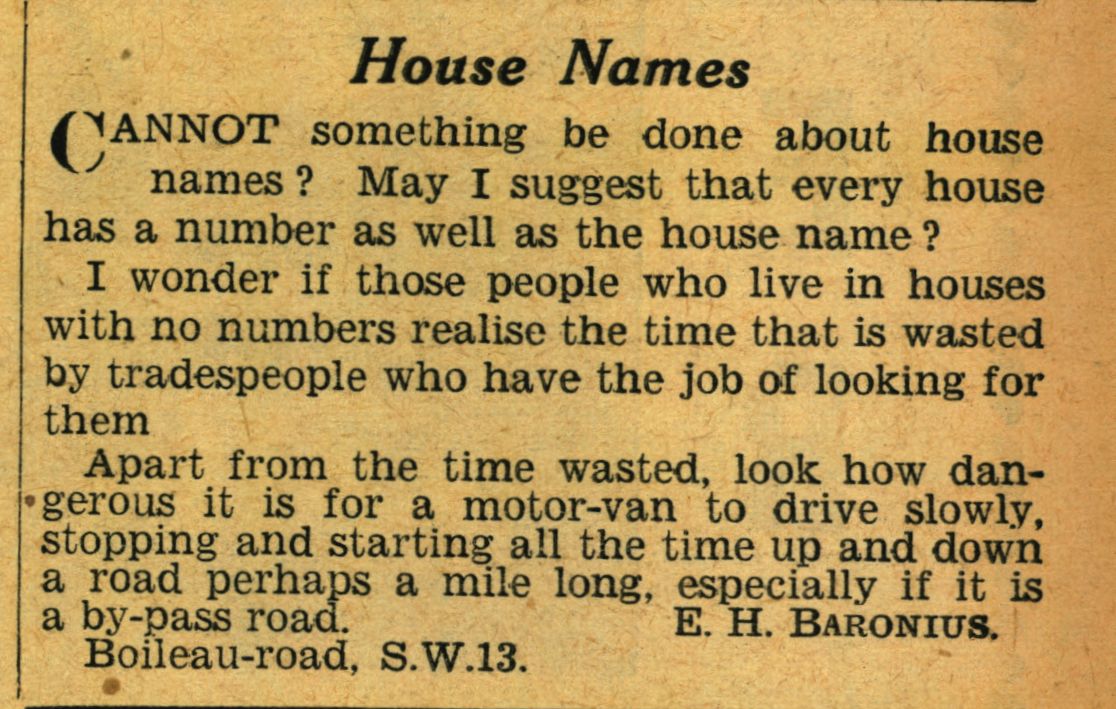
An aggrieved reader of the Daily Mirror in on 18th August 1937, complains about the fashion for naming rather than numbering houses. http://www.findmypast.co.uk
Beyond these churlish quibbles, though, there were some real concerns about the use of house names. Worried citizens felt that the extra time spent looking for a house name rather than a number might delay the arrival of telegraph boys or emergency services. Others felt that house names made the job of the Post Office much slower and more difficult. “It must be realised that a number gives what a name cannot do, a clue to the exact position of a house!” lamented the Halifax Evening Courier when describing difficulties with the Christmas post in 1926. The same article suggested that “some people deserve to be made to pay for their indulgence in such affectation,” calling for house names to be registered for a fee to dissuade too many people from using them.
But despite the detractors, house-naming persisted as a delightful quirk of British life; at heart, we all want to name our castle. With this in mind, it is perhaps right that we leave the last word on house names to the afore-mentioned journalist on the Morecambe Guardian who, in March 1930, on a walk through ‘a new estate of subsidy houses’ spotted a corker of a name and opined, “Some of these house names show what brave men and what hopeful householders we have in this country…. I find one owner has already put on his plate, ‘Stonehenge.”
Family History Research Services.
Websites Useful For UK Family History
Magazines
Discover Your Ancestors (online periodical): https://discoveryourancestors.co.uk/
Who Do You Think You Are? Magazine: https://www.family-tree.co.uk/
Family Tree Magazine UK : https://www.family-tree.co.uk/
Commercial Genealogy Sites
Find My Past: https://www.findmypast.co.uk/
The Genealogist: https://www.thegenealogist.co.uk/
Ancestry UK: https://www.thegenealogist.co.uk/
Newspapers British Newspaper Archive: https://www.britishnewspaperarchive.com/
Discover more from searchmyancestry - Ruth A. Symes
Subscribe to get the latest posts sent to your email.


House names can also provide valuable clues to the owners’ family history. I was stuck on a family of Murphys (the most common surname in Ireland) till l remembered that a generation earlier the family home was called Canovee which is the name of a parish in West Cork. And that was where l found them.
LikeLike